


.png.webp?17603559213260)
Mass Finishing Media Selection Guide
Developing an effective mass finishing process requires the crucial step of selecting the appropriate media. The right choice enables a wide range of outcomes, from rough deburring to high-gloss mirror polishing. The composition of the working media varies depending on the operation's purpose, the part material, and its geometry.
While media selection often lacks a single definitive solution and is frequently optimized through experimentation, key guidelines should be followed when purchasing mass finishing media.
Media is characterized by several critical properties:
- Material
- Shape
- Size
- Abrasive Characteristics
Selection begins by defining the part to be processed and the primary operations required. The part's material and processing goal determine the media material, while its shape, size, and features (holes, slots) dictate the optimal media form and dimensions.
Media Materials
Ceramic
The most versatile and widely used media, available with various abrasive properties and shapes to achieve different results.
Applications: Grinding, deburring, rust removal, oil residue cleaning, edge radiusing, and some surface polishing.
Best For: Steel, cast iron, and titanium components. May scratch non-ferrous metals.
Compatibility: All types of mass finishing equipment.
Note: Generates dust during dry processing.

Plastic
Less aggressive than ceramic media. Ideal for copper, brass, aluminum, and other non-ferrous metals. Does not leave marks on finished surfaces.
Applications: Grinding, deburring, rust removal, oil residue cleaning, edge radiusing.
Compatibility: All types of mass finishing equipment.
Note: Generates dust during dry processing.

Porcelain
Used for polishing steel, titanium, aluminum, and other materials. Features an extended service life (1-2 years depending on usage intensity).
Preparation: Requires 24-48 hours of "break-in" in the machine with water and compound before first use.
Process: Wet processing with compound.
Compatibility: All types of mass finishing equipment.

Stainless Steel
Used for smoothing, burnishing, and polishing components. The final result is a clean, smooth surface with a mirror finish.
Requirement: Parts must be pre-finished to remove scratches and imperfections.
Compatibility: Various types of mass finishing machines.
Corn Cob & Walnut Shell
These organic materials are used for drying components and dry final polishing.
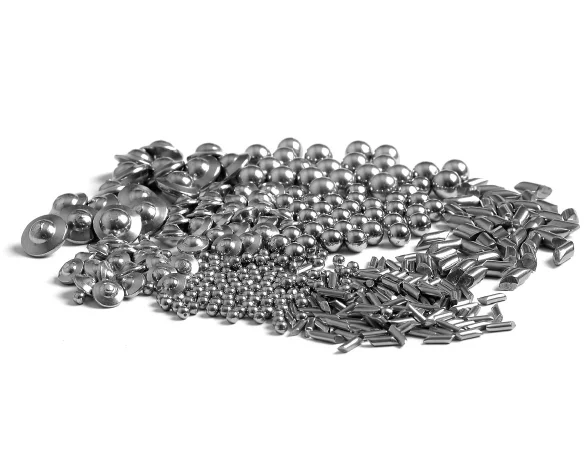
Zirconia
The most durable media material mentioned. Used for final finishing and high-gloss polishing.
Process: Wet processing with compound.
Action: Minimal metal removal; primarily burnishes, compacts, and polishes surfaces.
Compatibility: All types of mass finishing machines in wet processes.
Properties: Zirconia balls exhibit high resistance to chipping, abrasion, and cracking.

These materials provide different processing characteristics and effects, enabling selection of the most suitable option for specific operations. Always follow manufacturer recommendations and ensure machine safety for optimal results.
Media Shape and Size
For spherical or cylindrical parts, optimal results are achieved with ball, cylinder, or cone-shaped media.
For flat parts, or those with grooves and complex angular geometries, better performance comes from pyramid, prism, ellipse, or angled prism shapes.
Size selection must account for grooves and holes: media must not lodge in cavities yet must access and finish internal edges when required.
Mixtures of media with similar abrasiveness but different shapes and sizes are often used to achieve required surface finish quality, effectively treating both holes and external surfaces.
Larger media processes surfaces faster due to higher impact forces. Abrasive media (ceramic, plastic) wear over time, generating dust and reducing in size.
The angled prism shape delivers highest productivity. As it wears, it reduces in size while maintaining its angled form, preserving its "cutting" properties almost unchanged.
Use small media for fragile and thin-walled parts.
Use larger media for hard materials.
If small media processes too slowly, consider adding 1/3 volume of larger media.
If media and parts are similar in size, separation after processing becomes difficult. Generally, media should be smaller than parts but not so small as to lodge in holes. The simplest separation methods are sieves or machine separators; magnets are also effective in some cases.
Media-to-Part Ratio
Determining the optimal media-to-part ratio is essential. Overloading parts beyond manufacturer recommendations can cause part-on-part contact, scratching, and damage.
Volume Ratio Guidelines:
1:1 - Equal volumes of media and parts.
Insufficient media causes heavy part impact and scratching.
Suitable for castings, rough grinding, and applications with low surface roughness requirements.
2:1 - 2 parts media to 1 part parts.
Gentler processing but still allows part contact and potential damage.
Often used for edge radiusing, deburring, and flash removal.
3:1 - 3 parts media to 1 part parts.
Some part contact remains.
Acceptable quality for ferrous metals; minimum ratio for non-ferrous metals.
4:1 - 4 parts media to 1 part parts.
Optimal for ferrous metals; provides medium quality for non-ferrous metals (copper, aluminum, etc.).
5:1 - 5 parts media to 1 part parts.
Ideal for non-ferrous metals; minimal part-to-part contact.
6:1 - 6 parts media to 1 part parts.
Typically used for zinc pre-treatment with plastic media; ideal for non-ferrous metals.
8:1 - 8 parts media to 1 part parts (and higher).
Used for fragile or irregularly shaped parts, and for higher quality pre-finishing.
Very heavy parts (over 4 kg) should be processed separately, either in different machines or in trough-type machines with special dividers, to ensure optimal protection against damage during processing.


