
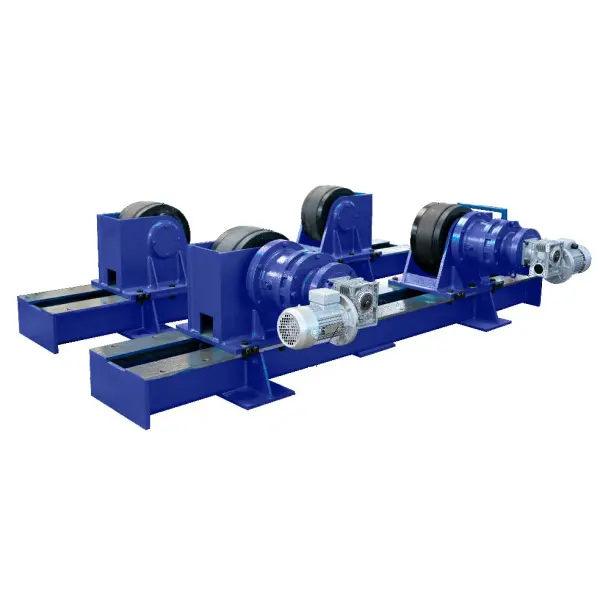
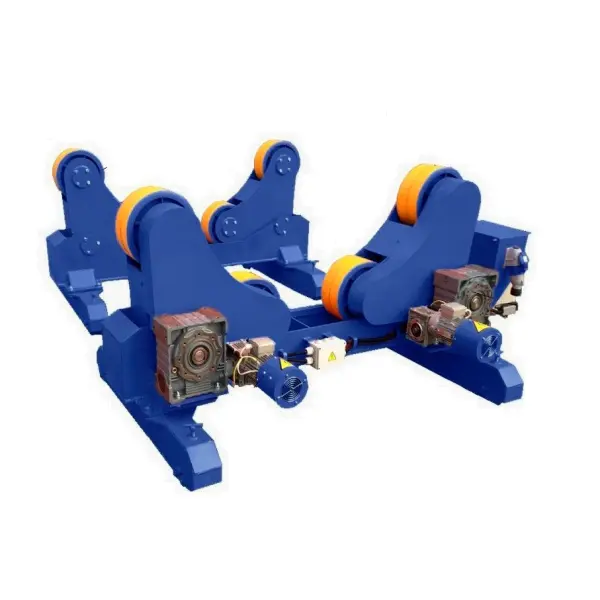
Most often, proper centering and smooth rotation of the shell are sufficient — software adaptation for each workpiece turns out to be unjustifiably costly. Roller devices are used to optimize the process and reduce setup time, allowing workpieces to be turned without the need for complex readjustments.
Classification of Roller Rotators
The design of a modern rotator varies depending on the configuration:
- stationary and mobile;
- driven and idle;
- with single or balancing (self-centering) rollers.
The main selection parameters are load capacity, workpiece type, and requirements for positioning speed and accuracy.
Drive and Positioning Accuracy
The key task of any rotator is to ensure stable operation. Simpler models use a standard asynchronous motor with a gearbox. For tasks requiring higher precision and stability, DC motors with pulse-width modulation (PWM) and frequency converters are used. This reduces the risk of defects and ensures precise adherence to processing parameters. In both cases, control is performed by the operator using a control panel or pedal.
Additional supports and balancing mechanisms are used to compensate for runout and stabilize the workpiece position. The type of rollers and support mechanism is selected based on the mass and geometry of the pipe.
Materials and Grip
The surface of welding roller rotators can be made from various materials:
- Vulcanized rubber — for loads up to 1 t per support;
- Polyurethane — provides increased wear resistance and improved grip;
- Steel — used in heavy-duty systems (loads up to 100 t). Combined designs, where the main roller is made of a soft material and the side rollers are steel, provide both grip and stability under load.
Spring and mechanical compensators are used to improve load distribution, reduce the impact of runout, and allow handling of long workpieces. This is important for automated welding or laser processing, where shell axis deviations of up to 1 cm per meter of length are acceptable.
Stabilization and Control Systems
Heavy-duty equipment series use Anti-drift technologies. These may include:
- Systems with lifting idle rollers to correct movement along the rotation axis;
- Mechanisms with angular roller tilting to provide high positioning accuracy.
The electronics of the rotators are simple and easily integrated into production lines: from relay control of asynchronous motors to operation with stepper and servo drives. This allows integration of rotators into robotic complexes without modifying the control systems.
Range and Readiness for Implementation
The company «Intellectual Robot Systems» supplies the full range of roller rotators — from low-power manual units to heavy industrial solutions with diameters of several meters. Equipment can be in stock or manufactured to order. Upon request, integration into existing welding infrastructure with full technical support is possible. If you plan to purchase equipment but have questions about price or technical details, our engineers are always available to assist. They will provide detailed consultations and help select the most efficient and convenient option.
The product warranty is 12 months. Delivery is available to any country. More details can be found in the corresponding tab on the product page.


