
В данный момент нет активных товаров
Laser Hardening

Laser hardening can be applied to both new and in-service parts. The advantages of the process allow for increased service life, reduced maintenance intervals, and minimized downtime — all without changing the part design. Aerospace, power generation, automotive, marine, heavy equipment, and manufacturing industries can also benefit from lighter-weight components while maintaining or improving metal fatigue strength.
In summary, laser hardening is used for the following purposes:
- increasing fatigue life;
- improving resistance to corrosion cracking;
- enhancing corrosion resistance;
- increasing fatigue strength and durability;
- improving microstructure, mechanical properties, and hardness;
- importance of compressive residual stress.
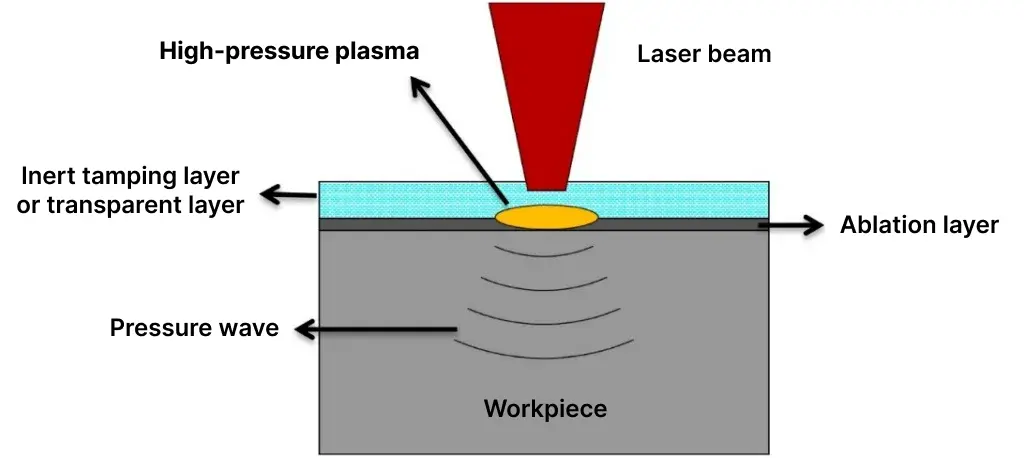
Laser hardening is a mechanical (cold-working) process in which high-intensity laser pulses impact the surface and generate shock waves. These waves plastically deform the surface, and compressive stresses propagate into the depth of the material. These dynamic compressive stresses are highest at the surface and decrease with depth.
When determining the fatigue strength or damage tolerance of a component, the net stress state is the sum of all existing stress states, including applied and residual stresses. In general, most fatigue-prone components fail when subjected to high tensile stress or cyclic tensile loading concentrated at the surface of the part. Tensile stresses exacerbate microscopic cracks in the material, growing tiny cracks until they become large cracks. When a component is strengthened with compressive residual stresses, it can withstand greater tensile loads before cracking and failure occur. Stronger compressive residual stresses provide a greater buffer against tensile deformation, and deeper compressive stresses inhibit crack initiation and propagation beneath the surface.
Laser Hardening Process Diagram

Laser beam impact

The processed volume is plastically deformed (cold working) and differs in size from the original

Surrounding material elastically adapts to the plastically deformed volume

Elastic deformation results in residual stress
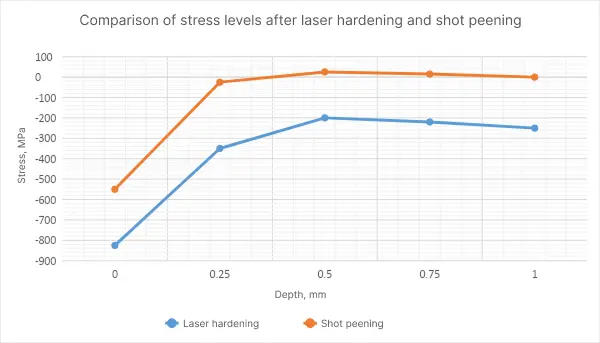
Currently, the most widely known and commonly used method for inducing compressive stresses on part surfaces is shot peening. Due to its advantages, shot peening is used at many metalworking enterprises in the production of gears, cams, springs, shafts, for scale removal, surface finishing of castings, etc. However, laser hardening has its own advantages compared to shot peening.
It has been demonstrated that laser hardening provides more than a tenfold increase in service life for components previously treated only by shot peening. This type of life extension is unmatched among surface enhancement methods and has the potential to revolutionize many industrial practices. Laser-treated parts not only last longer but can also be manufactured using less material, reducing costs and increasing efficiency.

Hardening of an automotive steering shaft

Replacement of shot peening of a large crankshaft with laser hardening

Laser hardening

Shot peening
Advantages of Laser Hardening
- greater depth of compressive residual stresses on the metal surface, reaching approximately 4–5 times greater depth and intensity compared to shot peening;
- better surface finish compared to shot peening, where roughness can only be reduced by grinding or polishing;
- ability to process grooves and fillets unlike shot peening;
- ability to process complex geometries due to laser beam delivery technology;
- possibility of integration into highly automated production lines.
Robotic systems can be used for laser hardening of parts, enabling fully automated processing. A typical robotic cell has the following configuration:
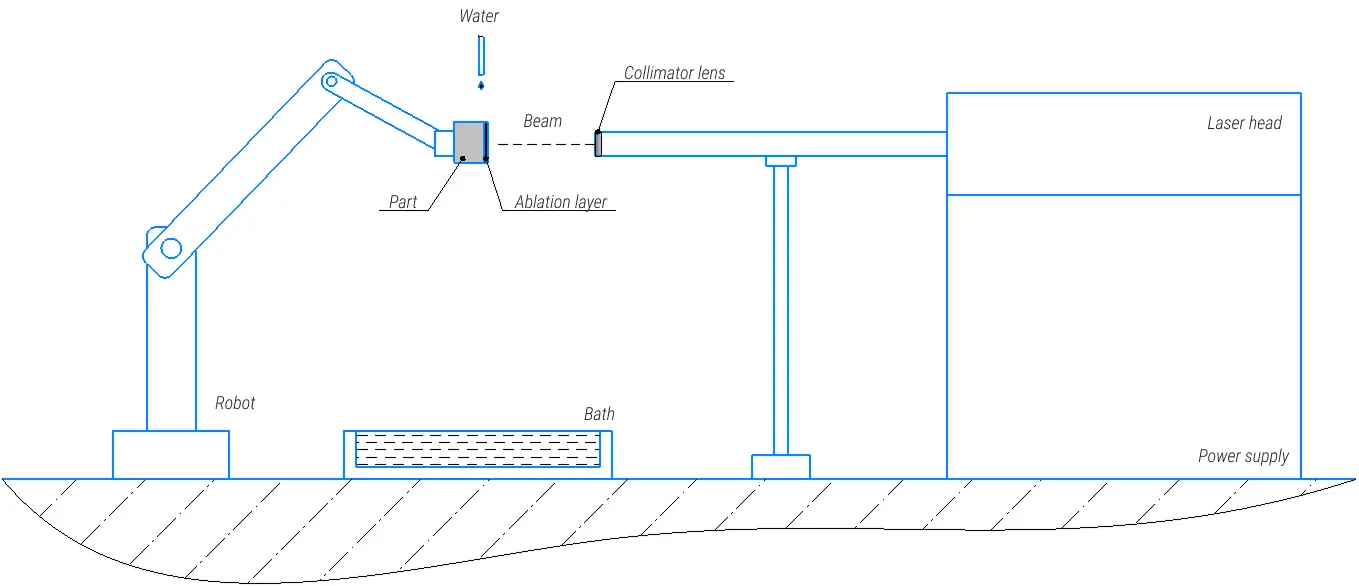
To ensure hardening of the required zone, the workpiece is moved relative to the laser beam by a six-axis anthropomorphic robot.


