
К сожалению, раздел пуст
В данный момент нет активных товаров
В данный момент нет активных товаров
Laser Drilling

Laser drilling machines are designed to drill micro-holes (<1 mm) in metallic and non-metallic materials. The simultaneous operation of the machine’s positioner, which holds the workpiece, and the machine head, which has up to three axes of movement, allows processing of workpieces with highly complex geometries. Critical micron-sized holes (<1 mm) are in high demand to enhance the performance of aircraft engines. These holes are created either using electrical discharge machining (EDM) or laser with short pulses. Nickel-based superalloys are typically used in technologically advanced industries such as aerospace, nuclear, marine, etc. Ensuring the quality of such holes is a challenging task, as these processes cause multiple defects due to the intense thermal energy used for material removal and vary in productivity. Therefore, equipment selection must consider both product quality requirements and process productivity.
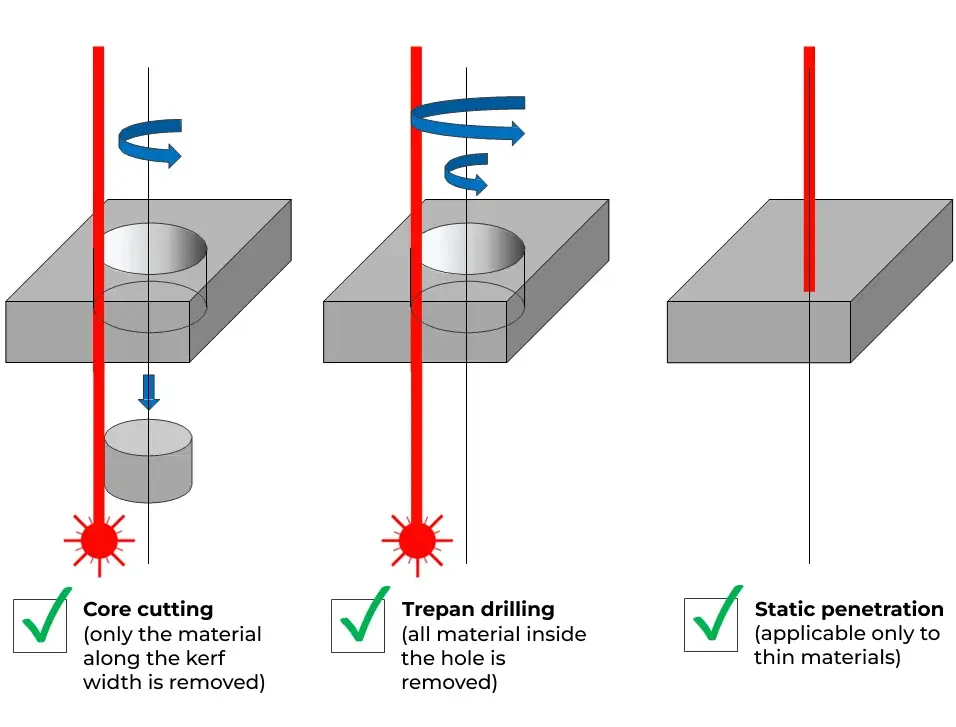
Laser drilling is essentially a thermal process, carried out in the following stages:
(a) laser energy absorption,
(b) substrate heating via thermal conductivity,
(c) melting and boiling,
(d) vaporization,
(e) plasma formation and ejection of molten material.
For millisecond and microsecond pulses, the material melts and vaporizes, while for ultrashort pulses, such as femtosecond pulses, direct material vaporization occurs. Radiation absorption is an important and desirable phenomenon during laser material processing. After the laser pulse ends, cooling begins, which usually lasts longer than the heating period, and at the same time, part of the melt that was not removed solidifies completely and adheres to the inner walls. This remaining melt forms a thin layer along the sidewalls, called the "recast layer." Since re-solidification occurs at a different rate, i.e., over a short period, this layer has a microstructure different from the base metal.
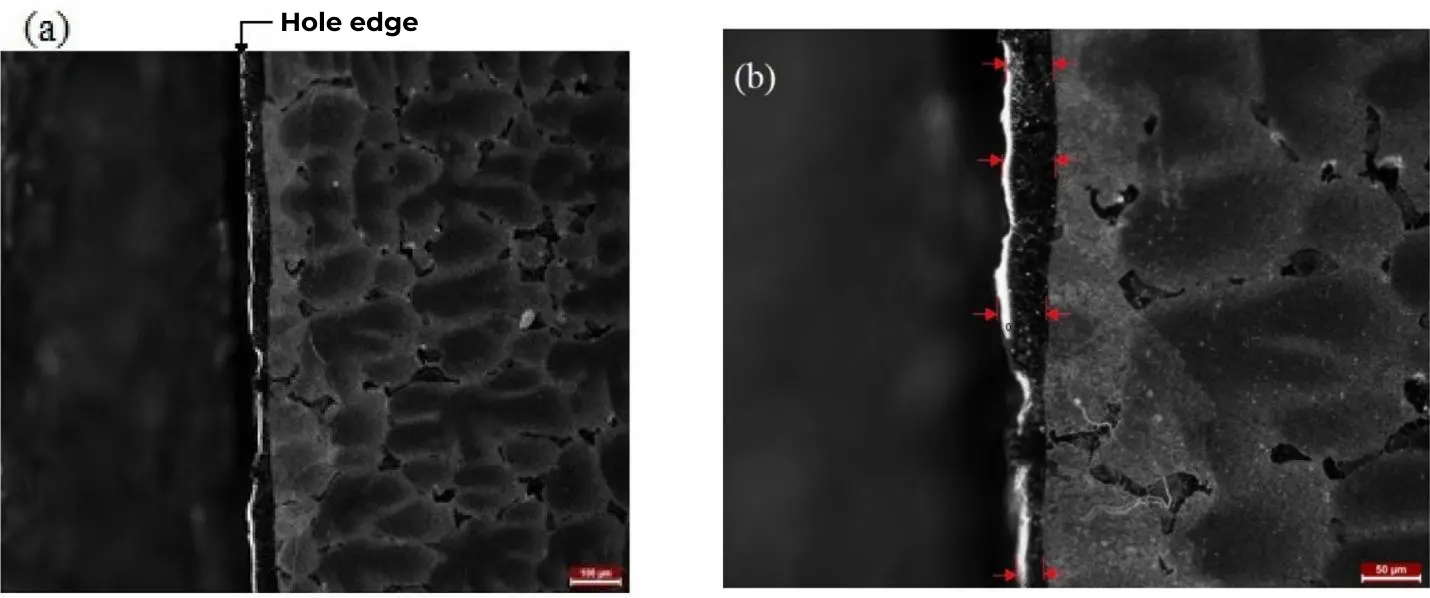
Figure 1.
Microsections of the recast layer:
a) – 100× magnification,
b) – 200× magnification.
Currently, there are several main methods for producing micro-holes:
electrical discharge machining (EDM);
dry laser drilling;
water-jet guided laser drilling (WJGL);
ultrashort pulse laser drilling (USP laser).
Each of these methods has its advantages and disadvantages. For example, the most productive process among these is dry laser drilling. Drilling a 0.55 mm diameter hole in a nickel alloy with a depth of 6 mm takes only 2 seconds, whereas drilling the same hole using EDM takes 40 seconds. However, the quality of the holes produced by these methods will differ.
| Process | Hole Roundness | Taper, ° | Roughness, Ra, µm | Modified Layer Thickness, µm | |
| Entry | Exit | ||||
| EDM | 0.144 | 0.044 | 0.71 | 3.67 | 11.41 |
| Dry laser | 0.115 | 0.143 | 1.13 | 2.82 | 34.73 |
| WJGL | 0.024 | 0.015 | 0.31 | 1.81 | 2.30 |

Figure 3.
Microsections of holes (Ø0.8 mm, 50× magnification): Dry laser – entry, b) Dry laser – exit, c) WJGL – entry, d) WJGL – exit, e) EDM – entry, f) EDM – exit.
The EDM process, due to the electrode’s flexibility, allows drilling holes in areas inaccessible to the laser beam, or "out of sight." However, the key advantage of laser methods over EDM is that they can drill non-conductive materials. This can be important, for example, when a part has a thermal ceramic coating. A universal solution for processing such blades is a machine with combined EDM+Dry laser technology. It allows drilling through the ceramic layer of the blade by ablation and then finishing the remaining metal portion using EDM. Intelligent Robot Systems LLC can select and supply a hole drilling machine using EDM, Dry laser, WJGL, or USP laser technology, tailored to your quality and productivity requirements.
Processing examples



Reviews


