

This system is a new generation complete thermal spraying unit. It integrates perfectly into modern automated or robotic spray coating systems and provides unchallenged process control...
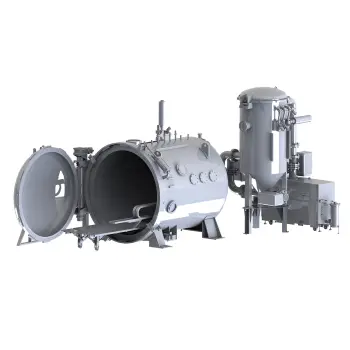
This machine provides the ability to carry out spraying process in argon atmosphere. Process begins by reducing pressure inside process chamber to below 0.1 mbar by pumping out air, after which the chamber is filled with argon. This ensures spraying process protection...
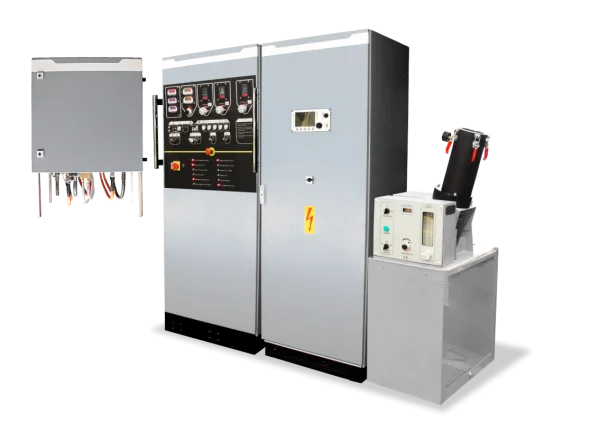
This system is the optimal solution for manual plasma spraying. The entire process is controlled manually from a single operator panel, making the system extremely simple and easy to operate. The use of modern control system components ensures high-quality coatings, and the process is reliable and safe.
Process Features
During plasma spray, powder inside or outside the plasma torch is melted by a plasma jet and accelerated toward the part being sprayed. The plasma is generated by an electric arc burning between the central cathode and the water-cooled anode of the plasma torch. The arc itself burns in argon, hydrogen, helium, or a mixture of these gases. During combustion, the gases dissociate and ionize, achieving high velocity at the exit and, upon recombination, transferring their heat to the sprayed particles.
Typical Applications (APS)
| Aerospace | Gas turbine and airframe components |
| Automotive and Transportation | Engine and transmission components, release coatings |
| Power Engineering | Gas turbine components and housings, hydroelectric turbine components, steam turbine components, solid oxide fuel cells |
| Pulp, Paper, and Printing | Anilox rolls, press rolls, steam boilers, digesters, papermaking rolls and components |
| Metalworking | Guide rolls, extrusion rolls, extrusion dies |
| Petrochemical | Pump components, valves, tank linings |
| Electronics | RF shielding, insulators, silicon die manufacturing equipment |
| Textile Equipment | Draw rollers, thread guides |
| Marine | Antifouling coatings, anti-slip mats, propellers, shafts |
| Consumer Goods | Household Irons, frying pans, pens |
| General Industry | A wide range of applications for surface restoration and functional surface finishing |
Sprayable Materials
There is an extremely diverse range of materials used for atmospheric plasma spraying, each capable of providing one or more surface properties. The range of powder materials for atmospheric plasma spraying includes the following:
- Pure metals.
- Alloys and superalloys.
- Metallic mixtures and composites that fuse during the spraying process.
- MCrAlY materials, consisting of nickel, cobalt, iron, or combinations of these metals, alloyed with chromium, aluminum, and yttrium.
- Cermets, used to reduce thermal mismatch between the workpiece and the ceramic top layer.
- Carbides.
- Self-fluxing alloys, which can subsequently be reflowed to produce coatings of maximum density.
- Abradable materials are mixtures or composites of metal alloys and various second and third phases, specifically designed to provide optimal performance in sealing gas paths.
- Ceramics.
To further meet specific customer needs, many of our powder materials are available in multiple particle size distributions.
Coating Examples
| Composition | Coating Properties |
| Ceramics | |
| Cr2O3 99.5 % | Coatings are highly hard, corrosion- and wear-resistant, and insoluble in acids, alkalis, and alcohol. Used for spraying anilox rollers for printing machines, wear rings, and pump seals. |
| ZrO2-Y2O3 93/7 | Maximum coating operating temperature up to 1320°C. Coatings have high purity and good thermal insulation properties, as well as high resistance to hot corrosion. Used for thermal barrier coatings in aircraft and stationary gas turbine units. |
| Cr2O3-TiO2-SiO2 92/3/5 | Coatings are highly hard, dense, wear-resistant, and corrosion-resistant. They also have high resistance to mechanical impact. |
| Al2O3 | The resulting Al2O3 coatings exhibit high resistance to corrosion, abrasive wear, erosion, and sliding wear. They also have excellent dielectric properties. |
| Al2O3-TiO2 60/40 | Maximum coating operating temperature up to 540°C. They exhibit high wear and erosion resistance. They are easy to process. They exhibit low wettability, allowing for additional polishing. These coatings are used in the textile industry and in household applications (spray coating on cookware). |
| Al2O3-TiO2 97/3 | Maximum coating operating temperature up to 1100°C. This coating is used for corrosion protection and exhibits high resistance to abrasive wear and sliding wear. It is primarily used for spray coating of thread guides in textile machines and rollers in papermaking machines. |
| ZrO2-Y2O3 80/20 | Maximum coating operating temperature up to 1150°C. Used when required for thermal barrier coatings. |
| ZrO2-Y2O3 93/7 | Maximum coating operating temperature up to 1320°C. The coatings are highly porous, exhibit excellent thermal insulation properties, and are highly resistant to thermal shock and hot corrosion. It is used for thermal barrier coatings in aircraft and stationary gas turbine units. |
| Y2O3 | Used for spraying graphite sheets in the metallurgical industry. It has good thermal insulation properties in aggressive environments. The maximum coating operating temperature on graphite is 1550°C. |
| Carbides | |
| WC-Co 88/12 | The coatings have high hardness and density, with high resistance to abrasive, erosive, and sliding wear. The coatings are sprayed onto machine parts. |
| WC-Co NiSF (self-fluxing matrix) 50/50 | The coatings have high erosion and abrasive resistance. Used for spraying plungers in the glass industry, pump plungers and bearings, and extrusion screws, and for spraying shafts in the metallurgical industry. |
| TiC | Coatings have high hardness and wear resistance. |
| Cr3C2 | Maximum coating operating temperature up to 870°C. The coatings have high hardness and wear resistance. |
| Cr3C2-NiCr 75/25 | Maximum coating operating temperature up to 870°C. Used for spraying shafts in the metallurgical industry. |
| Metals and Alloys | |
| NiCr, 80/20 | Maximum coating operating temperature up to 980°C. The coatings have good oxidation and corrosion resistance and are easy to process. Used for restoration, anti-corrosion coatings, and as a basecoat. |
| NiAl, 95/5 | Maximum coating operating temperature up to 800°C. The coatings have good oxidation and corrosion resistance and are easy to process. |
| Mo (Molybdenum) | Maximum coating operating temperature up to 320°C. When exposed to oxidizing environments, the coatings have good density, hardness, excellent sliding properties, and good adhesion. Used for spraying valves, synchronizers, piston rings, pump parts, etc. |
| Mo-NiSF 75/25 | Maximum coating operating temperature up to 350°C. The coatings have high wear resistance and good sliding properties with a low coefficient of friction. Used for piston rings, etc. |
| NiCrMoNb | Maximum coating operating temperature up to 1000°C. The coatings have high oxidation and corrosion resistance. Used for spraying coatings in boilers and the chemical industry. |
| Inconel 718 | Coatings have high corrosion resistance. Used in high-temperature working environments. Used in the chemical industry and turbine units. |
| Co 28Mo 8Cr 2.5Si | Appropriate for dry sliding. The coatings have high resistance to oxidation and corrosion. Used for restoring shaft journals and sliding guides. |
| Mo-Mo2C | Maximum coating operating temperature up to 320°C in oxidizing environments. The coatings have good density and hardness, high wear resistance, and good sliding properties. |
| Tantalum | The coatings offer good corrosion protection in acidic environments. The coatings are stable at high temperatures in non-oxidizing environments. They have a high melting point and have good adhesion to graphite, quartz, and aluminum oxide. |
| Titanium | High coating purity, high corrosion resistance in salt water, solvents |
| Niobium | Exhibits high corrosion resistance to acids and excellent high-temperature stability in non-oxidizing environments. |
| MCrAIY | |
| NiCoCrAlYHfSi | Maximum operating temperature of the coating: 850–1050 °C. The coatings exhibit high stability when operating at elevated temperatures in hot, corrosive, and oxidizing environments. Stable at high temperatures in hot corrosive and oxidizing media. Used for spraying the bond coat layer of thermal barrier coatings. |
| NiCrAlY | The coatings exhibit high stability when operating at elevated temperatures in hot, corrosive, and oxidizing environments. Used for applying coatings on turbine blades. |
| CoCrAlYTaCSi-Al2O3 90/10 | Maximum operating temperature of the coating: up to 1050 °C. The coatings feature good anti-sticking properties and high wear resistance. Used for applying coatings on furnace rollers during steel sheet annealing. |


