

This system is a new generation complete thermal spraying unit. It integrates perfectly into modern automated or robotic spray coating systems and provides unchallenged process control...
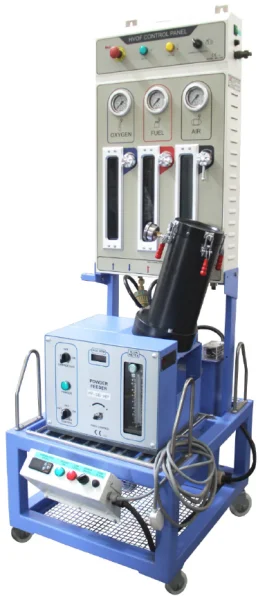
Features of the High-Velocity Spraying Process
Supersonic flame spraying involves the combustion of oxygen mixed with gaseous (hydrogen/propane) or liquid (kerosene/ethanol) fuel to produce a flame with high kinetic energy. The powder sprayed material is heated in a uniformly heated stream of hot gas to a molten or partially molten state. The combustion products and powder are accelerated in a Laval nozzle to achieve supersonic gas and particle velocities, which are directed toward the sprayed object. The powder particles flatten upon impact with the part, cool, and harden, forming a coating. The combination of high particle velocities, uniform heating, and short residence time of the molten particles in the air allows for the production of very dense coatings with good adhesion.
Comparison of HVOF Technologies Using Liquid (Kerosene/Ethanol) and Gaseous (Hydrogen/Propane) Fuels
| Process characteristics | ||
| Fuel | Hydrogen, Propane | Kerosene/Ethanol |
| Combustion Chamber Pressure | ~0.55 Pa | 0.55 to 0.83 Pa |
| Gas Velocity | 1800—2100 m/s | 2000—2200 m/s |
| Spray Particle Velocity | 450—600 m/s | 475—700 m/s |
| Spray performance | Up to 120 g/min | Up to 200 g/min |
| Average Porosity of Sprayed Coatings | ≤ 3% | ≤ 1% |
| Sprayed Coating Adhesion | ~ 70 MPa | ~ 70 MPa |
| Average Sprayed Coating Thickness | 200—500 µm | 200—500 µm |
| Noise level | 130 dB | |
| Average resource consumption comparison (per 1 hour of operation) | ||
| Fuel |
Hydrogen — 43800 l Propane — 5280 l |
28 l |
| Oxygen | 18420 l | 61400 l |
Typical Applications (HVOF)
| Industry | Typical Application |
| Petrochemical | Pump parts, gate valves, ball valves, valve seats, exhaust pipes, pump pistons, hydraulic piston rods, screw conveyors |
| General Industry | Pump housings, impellers, shafts, plastic extruders, cam followers, wear rings, press fits, repair components |
| Aerospace | Fan anti-vibration shelves, compressor blades, bearing spindles, stator and rotor locks, landing gear, actuators, flap guides, helicopter rotor assemblies and bearings |
| Electric Power | Industrial gas turbines, Pelton hydroelectric turbine ladles, nozzles and blades, exhaust fans |
| Automotive | Gearbox forks, hydraulic piston rods, pistons, steering |
| Metalworking | Steel guides and shafts, wire drawing winches, punches, sheet metal cutters |
| Textile Machinery | Yarn guides, pressure rollers |
| Printing and Paper | Printing drum covers, ink drums, calendar and stamping drum covers |
Examples of Sprayable Materials
| Composition | Coating Properties |
| Carbides | |
| WC-NiMoCrFeCo 82/18 | Can be used when a very dense and ductile coating with good abrasive, erosion, and sliding resistance is required. It has high corrosion resistance in seawater containing dissolved mineral and organic acids. Used for marine structural parts, petrochemical, and offshore components. |
| WC-Ni 88/12 | Maximum operating temperature up to 500°C. The coating has high corrosion resistance and excellent ductility. |
| WC-Co 88/12 (Agglomerated and sintered) | Maximum operating temperature up to 500°C. Coatings with high hardness and density, high resistance to abrasive, erosive, and sliding wear. The coatings have high adhesion and low oxidation and corrosion resistance. Used for general wear resistance applications, such as on shafts in the pulp industry, wire drawing equipment, compressor and fan blades, seals, and pump housings. |
| WC-Co 83/17 | Maximum operating temperature up to 500°C. Higher ductility than WC-Co 88/12. Hard, dense coatings with good resistance to sliding wear and impact. Low oxidation and corrosion resistance. Good protection against fretting and abrasive wear. Used for spraying various pump parts, anti-vibration shelves, fan blades in gas turbines, flap guides, extrusion dies, glass industry applications, paper machine shafts, and wire drawing equipment. |
| WC-Co Cr 86/10/4 | Maximum operating temperature up to 500°C. Used in humid, corrosive environments. Suitable for shafts, ball valves, and oil production equipment. |
| WC-CrC-Ni 73/20/7 | Maximum operating temperature up to 700°C. The coatings have high resistance to corrosion and oxidation. Can be used for spraying gate valves. |
| Cr3C2-NiCr 75/25 | Maximum operating temperature up to 870°C. Special powder developed for spraying shafts in the metallurgical industry. |
| (Fe,Cr)C-FeNiCrSi 70/30 | Maximum operating temperature up to 870°C. Coatings have high resistance to sliding wear. Used for spraying machine parts, piston rods, and as an alternative to galvanic coatings (hard chrome plating). |
| WC-WB-Co 60/30/10 | Provides protective properties against corrosion and wear. Can be used in zinc baths of continuous galvanizing lines. |
| Metals and Alloys | |
| CoCrWSiC | Coatings have high wear resistance and thermal shock resistance, as well as resistance to corrosion and active oxidation. Used for shaft seals in steam turbines and machine parts. |
| NiCrMoNb | Maximum operating temperature up to 1000°C. Excellent resistance to oxidation and corrosion. Typical applications: boilers and chemical industries. |
| NiCrMoNbAlTi | Suitable for corrosion-resistant coatings. Used in the chemical industry |
| Ni | Maximum operating temperature in open atmosphere up to 530°C |
| NiCr, 80/20 | Good coating fluidity |
| FeVCrCWMoMnSi | Does not provide protection against wet corrosion. Excellent sliding properties for machine parts, cylinder rods, and as a replacement for hard chrome plating (galvanic coatings) |
| Co 28Mo 8Cr 2.5Si | Used for dry sliding. Highly resistant to oxidation and corrosion. Can be used to restore shaft journals and slideways |
| Mo-NiSF 75/25 | Maximum operating temperature up to 350°C. Wear-resistant coatings with good sliding properties and a low coefficient of friction. Used for piston rings, etc. |


