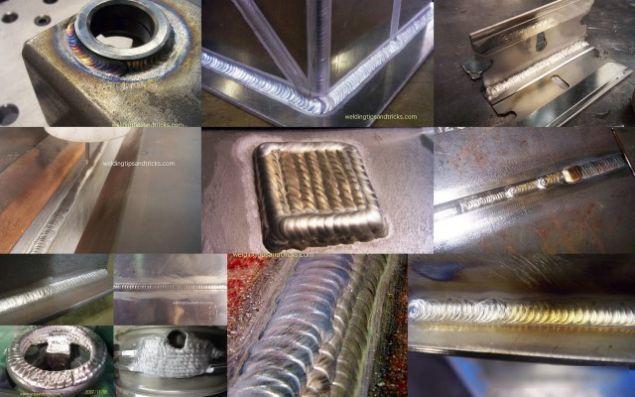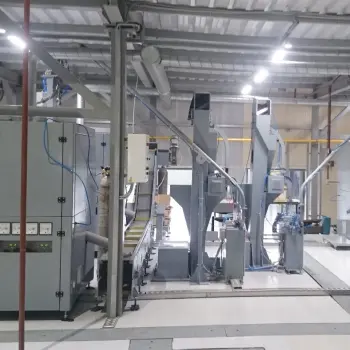
LLC "Intellectual Robotic Systems" implements projects and solutions for surfacing materials using various methods, from manual to automated, including the use of industrial robots.
Robotic and automated surfacing is being increasingly used in industry every year. At present, there are technologies that make it possible to perform surfacing along complex spatial trajectories on multiple planes, meaning that an entire part can be processed in a single setup in an automatic cycle. By using robots and additional peripheral equipment of the robotic system, as well as by integrating induction heating sources, it becomes possible to implement complex thermal processing cycles (hardening, tempering, aging, preheating).
The main technological feature of surfacing is the application of a layer with properties that differ radically from those of the base metal.
Diagram of automatic surfacing in a carbon dioxide atmosphere: 1 — nozzle; 2 — carbon dioxide supply tube; 3 — gas nozzle; 4 — contact tip; 5 — electrode wire

This method can be used both to create layers with increased wear resistance and to form transition layers.

The use of automated (robotic) surfacing makes it possible to manufacture products with the required physical properties while saving expensive materials. The use of robots for surfacing also significantly reduces production defects, and in some cases completely eliminates them. A robotic system allows the use of advanced welding equipment, the technology of which enables surfacing with minimal mixing of the surface layer with the base metal.

Surfacing can be performed on any geometric surfaces, from flat to complex-profiled ones. In industry, special attention is paid to restoring diameters — both bearing seats and diameters along the entire length of the product.