
The applied force is determined by system settings and pump parameters. The press can operate in manual, semi-automatic, or automatic modes, making it a versatile solution for various production tasks.
Structure and Working Principle of a Hydraulic Press
Contents:
Hydraulic press is a powerful machine used in industry to perform operations on workpieces under high pressure. The operation of a hydraulic press is based on Pascal's law, according to which the pressure applied to a fluid in a closed system is transmitted evenly in all directions. This allows a small force generated by the operator or a pump station to be converted into a large impact on the work area.
This principle makes the equipment reliable and versatile. It is used in various industries: metalworking, woodworking, waste processing, food, and chemical industries. Thanks to its well-thought-out design and high force output, hydraulic presses ensure precise operations and consistent quality of the final product.
Unlike mechanical counterparts, a hydraulic press can generate pressure gradually, without jerks, which is especially important when working with fragile or thin-walled materials. Moreover, it can be precisely adjusted for various technological processes, making it a universal solution for modern manufacturing.
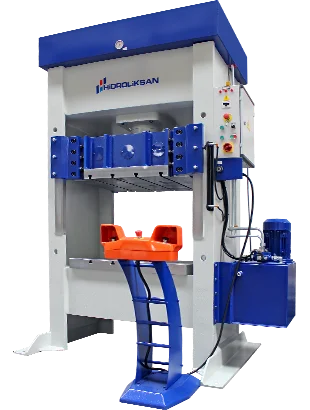
Types of Hydraulic Presses
Engineers classify hydraulic presses according to several criteria. These types differ in design, purpose, number of cylinders, and orientation of the working mechanism.
By design:
- C-frame — compact, with easy access to the working area. Ideal for small and medium-series work;
- Column (two- and four-post) — increased rigidity, capable of handling high force and large workpieces;
- Portal — versatile, convenient for working with large-sized products.
Each design type has its own characteristics and is used depending on production requirements. For example, C-frame presses are compact and suitable for workshops, while column presses are used in large factories where high force and stability are required.
By number of cylinders:
- Single-cylinder — consists of one power element.
- Multi-cylinder — used when it is necessary to evenly distribute force or create complex motion. For example, in large molds or when working with multiple pressure zones simultaneously.
By purpose:
- Stamping presses — used for cutting, bending, and drawing parts;
- Composite and powder presses — create dense products from bulk materials, especially important for automotive and instrumentation components;
- Vulcanizing presses — for processing rubber products;
- Scrap metal presses — compress waste into briquettes for transport and recycling.
By orientation:
- Horizontal — rare, but effective for pressing bushings and shafts. Their design allows working with elongated parts;
- Vertical — common, suitable for most operations, including forming, bending, and stamping.
All these types of hydraulic presses have their own advantages, and the correct choice depends on the production task. Before purchasing, it is important to clearly define the purpose and technical parameters required for completing production tasks.
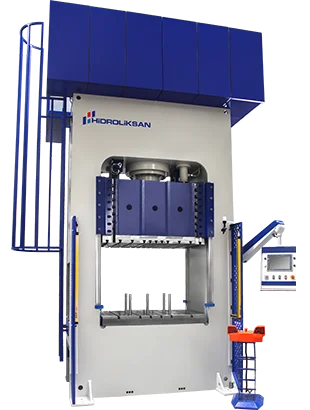
Hydraulic Press Components
The hydraulic press consists of main and auxiliary components, whose interaction ensures precise and reliable operation. The press includes the following elements:
Frame
The main structure providing stability and rigidity of the machine. It can be welded or cast as a single piece, capable of withstanding high pressure. The rigidity of the frame affects the uniform distribution of force and the durability of the equipment.
Work Table
Serves as the base for placing the workpiece. Equipped with T-slots or mounting holes for installing dies and tooling. Depending on the type of press and application, the table may be fixed or movable, with adjustable height.
Hydraulic Cylinder
The key element where fluid energy is converted into mechanical motion. The piston inside the cylinder receives pressure from the fluid and transfers force to the tool. Operation occurs strictly along the design direction defined by the manufacturer. Hydraulic cylinders can be single- or double-acting, depending on the task.
Hydraulic System
Includes:
- Pump — ensures fluid movement;
- Oil tank — necessary for continuous operation;
- Relays, filters, safety valves — control system parameters;
- Distributors — regulate fluid supply to the cylinder.
The fluid acts as the transmission medium. Its quality and level directly affect system stability. Using low-quality oil leads to malfunctions and rapid component wear.
Control System
Operated via levers, buttons, or automatic controllers. Modern models feature CNC and touchscreen interfaces, allowing flexible control of operational parameters. Programs set the motion cycle, pressure, speed, and duration of impact.
This setup enables precise adherence to parameters for both series and single-piece processing. The design adapts to specific tasks, making the equipment suitable for a wide range of industries.
Hydraulic Press Operating Principle
The hydraulic press operates as follows: pressurized fluid is delivered into the cylinder, acting on the piston. The piston begins to move and applies force to the workpiece through the tool. The action can be single- or double-acting. After the cycle is completed, the piston returns to its original position.
This principle allows relatively small energy input to generate significant force. The hydraulic machine operates smoothly, without jerks, which positively affects processing accuracy. Thanks to precise pressure control, the equipment is used for complex technological operations.
If necessary, the press can be equipped with additional features: heated work surfaces, part removal systems, pressure sensors, and die position sensors. All these enhancements improve precision and reliability.
Functions and Applications of a Hydraulic Press
A hydraulic press is a machine used for:
- Forming;
- Stamping;
- Bending;
- Punching;
- Straightening;
- Pressing waste;
- Producing powder-based products.
The main task of the equipment is to provide consistent force on the workpiece. It can be used in both cold and hot processes. The pressure is applied evenly, ensuring high-quality processing of the item.
Application areas:
- Automotive and aerospace industries;
- Metalworking;
- Die casting;
- Scrap and waste processing;
- Packaging production;
- Chemical industry;
- Manufacture of composite material parts.
The multifunctionality makes the press an excellent choice for enterprises of any scale. It allows production tasks to be carried out with high speed and accuracy.
Industrial hydraulic presses are in demand for both large-scale production and small or experimental batches. Thanks to adjustable force and stroke parameters, they are suitable for working with fragile materials such as ceramics, plastics, and polymers.

Tips for Choosing a Hydraulic Press
When selecting a hydraulic press, it is important to consider not only the force but also the type of construction, application area, and operating conditions.
Recommendations:
- Determine the purpose: bending, drawing, forming, or waste processing?
- Calculate the required force: from 10 to 1000 tons and above;
- Consider the table size and piston stroke;
- Choose the type of control: mechanical lever, panel, or CNC;
- Pay attention to reliability and construction — the frame should be stable;
- Ensure the availability of service support, spare parts, and upgrade options.
It is also important to understand the operating mode of the press: cyclic or continuous. For high-intensity work, it is advisable to choose models with forced oil cooling and an automatic lubrication system.
Our company offers only proven solutions for industrial use. We provide various types and models of hydraulic presses designed to meet the needs of modern production. All models comply with safety, energy efficiency, and reliability standards.
Visit our catalog to explore the range. Our engineers will help you choose the optimal solution for your specific task. Invest in reliable equipment and ensure the stability of your production today!
