
Recommendations for Choosing Tumbling Media
Selecting a tumbling media in most cases does not have a definitive solution and is usually determined experimentally. However, there are some guidelines that can be followed when choosing media.
The choice of media depends on the task, material of the parts, shape, processing mode, and type of tumbling machine.
Main advantages and applications of specialized tumbling media:
- Increases processing productivity
- Ability to remove cutting fluids, oils, scale, and rust
- Polishing to a mirror finish
- Grinding and deburring
- Allows rounding of part edges
- Works with cavities, grooves, and recesses
When choosing tumbling media, the following four important parameters should be considered:
- Media shape
- Media size
- Material
- Abrasive properties of the media
Shape and size of media
Media manufacturers can create almost any shape. However, when choosing media, the size and shape of the parts must be considered. Media should not get stuck in grooves or holes and must provide access to all surfaces of the parts.
To avoid media jamming, it is best to use angular stars and cones, while tapered shapes are most effective for passing through holes. Measure the holes or cavities and choose larger media that will not pass through or smaller media that will freely pass through the openings.
Keep in mind that media continuously wears down in size. When it becomes smaller, it can start to get stuck in the parts. Therefore, before replacing the media, the tumbling material should be used to the maximum.
The media must be able to contact all surfaces of the parts. For example, a tapered prism can contact a 90° corner and properly process it, while a cylindrical media cannot adequately process that part of the piece.
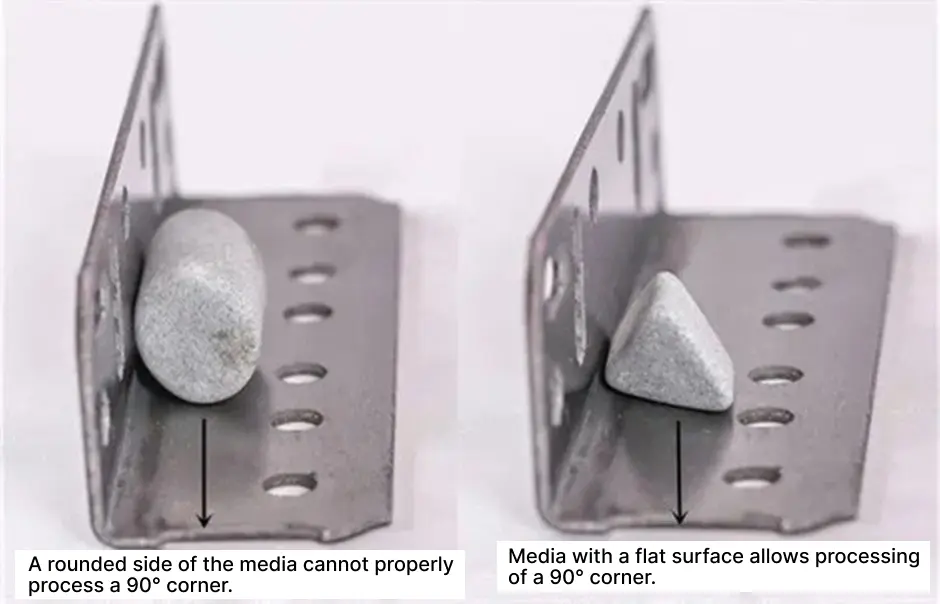
Larger media will provide faster cutting and finishing, whereas smaller media will produce slower but more delicate results.
For fragile and thin-walled parts, use smaller media. For hard materials, larger media can be used. If small media cuts too slowly, consider adding 1/3 large media.
Material
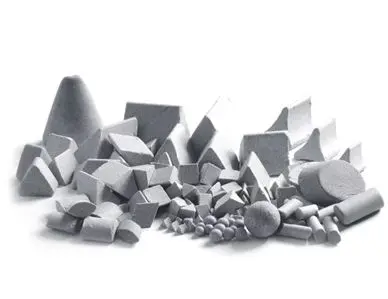
Ceramic tumbling media
For rough processing and hard materials such as steel, ceramic media is the best choice.
Ceramic media is also ideal when small-sized media is required. Additionally, it can remove burrs, round edges, and remove rust.
It can also process hard and heavy plastic parts much better than plastic media.
This material is available from light to heavy cutting with a large volume of abrasive material for fast deburring processes.
Plastic tumbling media
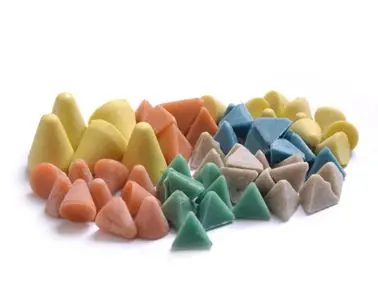
Plastic media is used for softer metals such as brass, copper, or aluminum. It provides a very smooth surface but produces a matte finish with slight shine.
Plastic media is 30% lighter than ceramic, causing fewer scratches. It does not discolor or stain parts and works well in pre-finishing stages.
Porcelain tumbling media
Another type of ceramic media is porcelain.
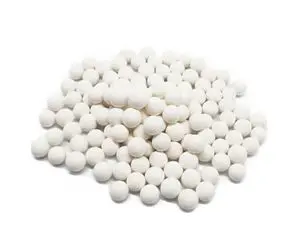
It is usually available in white and in three common shapes: cylindrical, triangular, and spherical.
The main function of porcelain is polishing metal surfaces and giving a mirror finish.
This process is usually done in two stages. After manufacturing, parts often have scratches and burrs, which can be removed with ceramic or plastic media. Then porcelain is used to polish the surface.
For soft metals like aluminum, spherical media is best. Cylindrical media is suitable for harder materials, such as steel.
Steel tumbling media
Steel media is available in various sizes and shapes, typically balls, cones, and pins.
Due to their very high density, steel media creates compressive stress on metal surfaces, resulting in surface hardening.
Steel media also has a very long service life. It not only improves surface shine but also reduces porosity in metal parts.
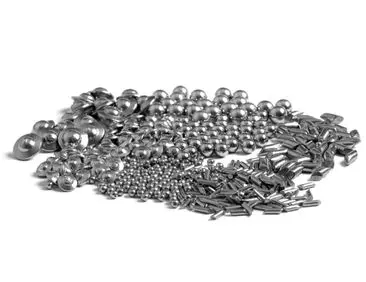
Comparison of different types of tumbling media by purpose and desired result
| Desired result | Intensity | Recommended media |
|---|---|---|
| Deburring | Light | Steel or ceramic |
| Medium to heavy | Ceramic or plastic | |
| Edge rounding | Light to heavy | Ceramic or plastic |
| Uneven surfaces | Arbitrary media shapes | |
| Surface roughness | Reduce to lower values | Ceramic or plastic |
| Pre-finishing of soft alloys | Ceramic or plastic | |
| Mirror finishing | Light shine | Steel or ceramic |
| High quality, hard alloys | Ceramic | |
| High quality, soft alloys | Plastic | |
| High quality, plastic parts | Wood | |
| Surface cleaning | All metals | Steel or ceramic |
