
As an example of a technological solution using gas-thermal spraying, let us focus on hip joint endoprosthetics. During this procedure, both the femoral neck and head, as well as the acetabulum (bipolar or total endoprosthesis), are replaced with artificial components.
Protective coatings - high-tech solution for implants
Currently, the task of import substitution of implants is actively being addressed by various Russian manufacturers with the goal of matching and exceeding the quality of global producers such as Zimmer Biomet, DePuy (part of Johnson & Johnson), Stryker, and Smith & Nephew.
When both joint components (head and socket) are replaced, the procedure is called total endoprosthetics. The prosthesis components can be fixed by press-fitting into the bone during surgery, known as cementless press-fit fixation. Subsequently, the bone grows into the porous surface or special grooves of the prosthesis. The prosthetic cup (pelvic component replacing the acetabulum) also has a porous coating for bone ingrowth in cementless fixation and can be additionally secured with screws. Some prosthesis models are coated with hydroxyapatite.
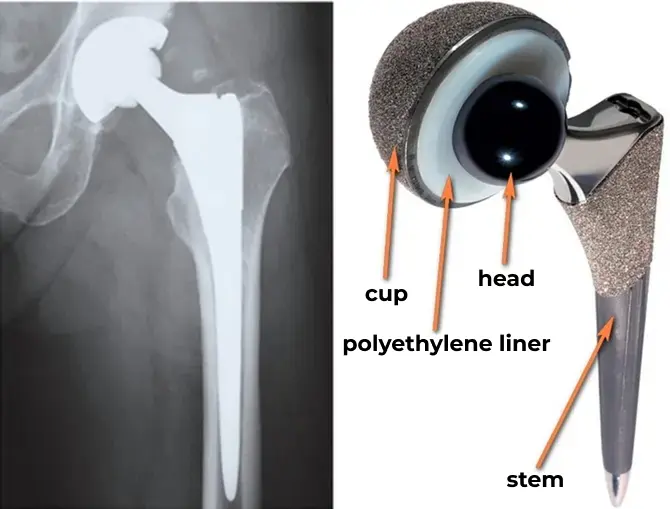
Total (bipolar, i.e., both femoral neck and acetabulum replaced) cementless endoprosthetics for femoral neck fractures. Left: X-ray after surgery. Right: external view of a cementless prosthesis with a porous coating. One of the most common cementless prosthesis configurations is shown, consisting of a cup, a high-molecular-weight polyethylene liner, a metal head, and a stem.
The roughened bone surface, facilitating bone ingrowth, can be created in various ways: compressed beads, wire, plasma titanium coating, or trabecular metal. The roughened surface may cover the entire stem or only the upper part located in the trochanteric region.
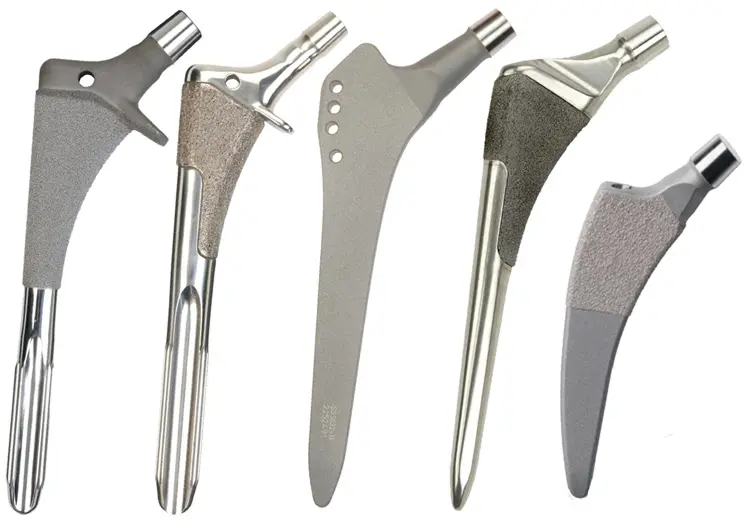
Stem surface variants of prostheses using previous Zimmer product lines as examples. From left to right: VerSys Beaded MidCoat stem with compressed bead coating, VerSys fiber metal stem with compressed metal fibers coating, Alloclassic stem with roughened surface obtained by sandblasting, Trabecular Metal Primary Hip Stem with trabecular metal surface, short Fitmore stem with plasma-sprayed titanium alloy coating.
Cementless cups, like cementless stems, are inserted into the acetabulum prepared with spherical reamers using the press-fit method.
Cups are made of titanium-aluminum-vanadium or titanium-aluminum-niobium alloy. The outer surface of the cup contacting the bone has a porous coating made of compressed beads, wire, or trabecular metal. Unlike cementless stems, sandblasting is not used for cups—the surface must be coarser for secure fixation.
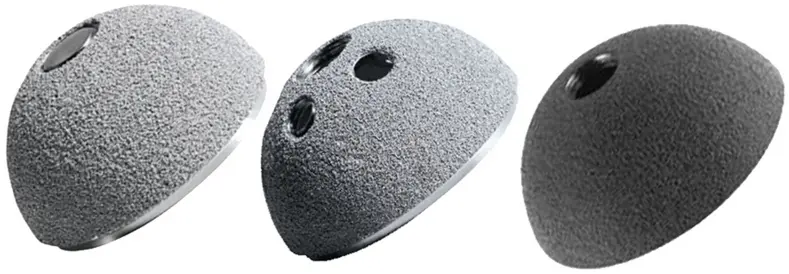
Outer coating variants of cementless hip prosthesis cups using DePuy Pinnacle cups as examples. Left – Porocoat® coating, a layer of compressed pure titanium beads. Center – Gription® coating, developed based on Porocoat with smaller pores and higher friction. Right – Duofix® coating, combining Porocoat with plasma-sprayed hydroxyapatite to stimulate bone ingrowth (35-micron layer, keeping pores open).
For acetabular defects or fractures, cups with holes on all sides may be required. Some cups have special teeth that increase stability and reduce rotation risk during subsequent loading.
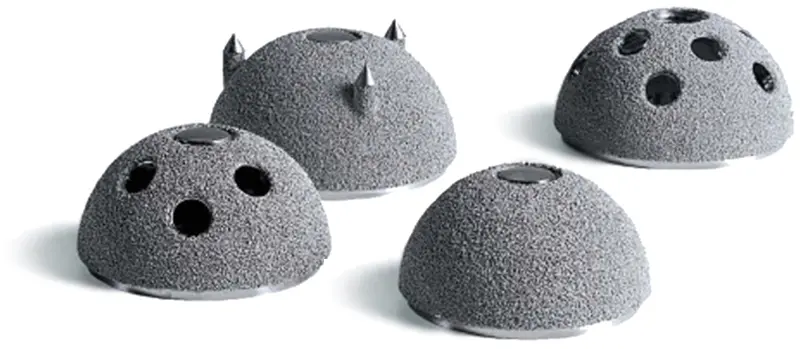
DePuy Pinnacle cup series. From left to right: cup with three holes, cup with teeth, cup without holes, Multihole cups (holes across the surface).
Porous structures on implant surfaces are created using atmospheric plasma spraying of special coatings, including oxide ceramics and titanium-based alloys. If you are interested in creating porous coatings for hip implants in your production, we invite you to contact us.
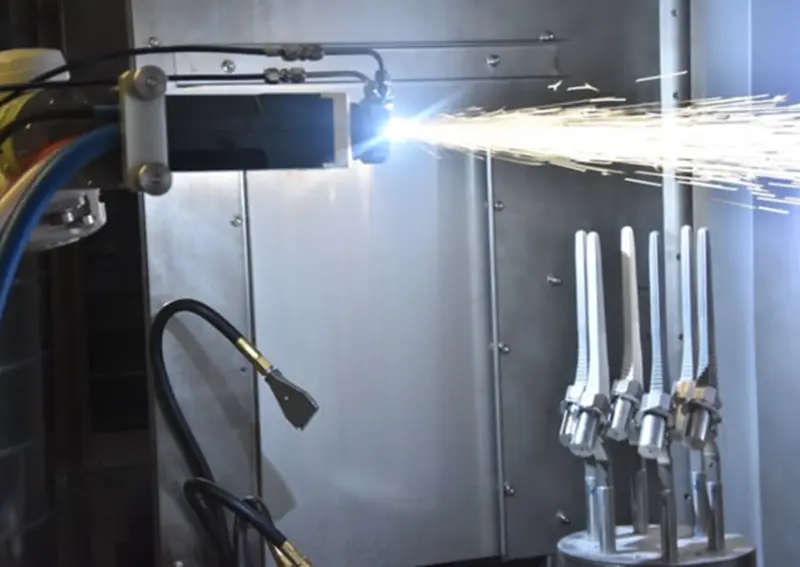
Atmospheric plasma spraying of a porous protective coating on the prosthesis stem.
Our specialists are ready, after reviewing your requirements, to develop a precision technology, implement production of the technological complex, provide supply, and train your company’s personnel.
Contact us: technology@irobs.ru
Products
All
203
Plasma Spray Systems
3
HVOF Spray Systems
2
Flame Spray Systems
6
Arc Spray Systems
2
