
Laser Cleaning
Contents:
Laser Cleaning vs All
In industrial and often laboratory settings, a constant main problem is cleaning working surfaces from contaminants. Many methods have been invented, but all of them have at least one or two significant drawbacks. However, engineering does not stand still, and instead of sandpaper, sand, or a set of acids/bases, coherent light appeared.

Praying to Mithra or the Sun is completely unnecessary. In the 1980s, lasers were already appreciated not only in theodolites and special communications—laser cutting machines started appearing everywhere. The basic idea quickly gained engineering refinements: it was enough to slightly modify the operating mode of the device to obtain an absurdly simple and universal cleaning method based on milling principles. The laser beam evaporates contaminants in ultra-thin layers from reflective or transparent surfaces.
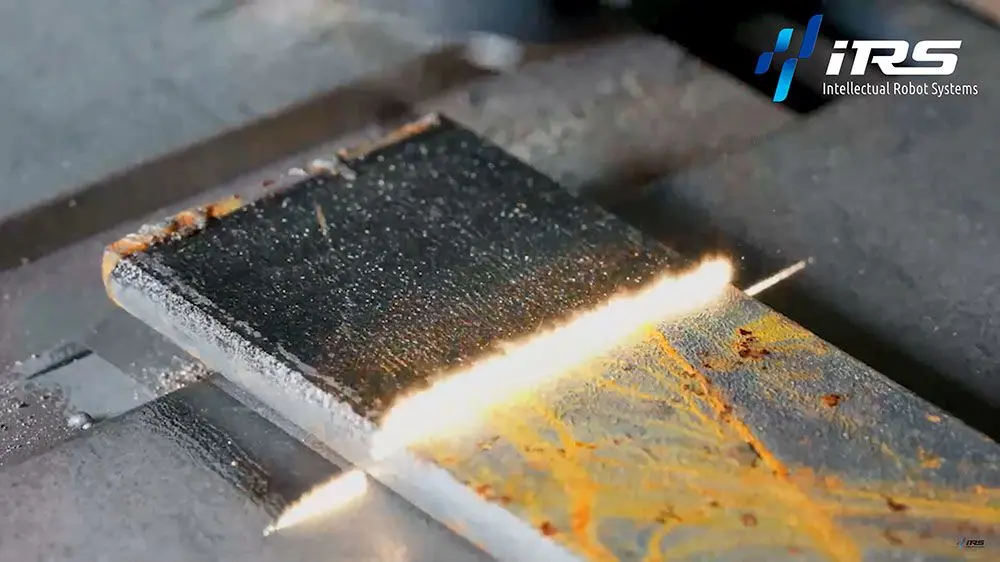
All technologies have their challenges, but the laser, like any newcomer, decided to try to become the best both in technology and accessibility: it requires no consumables and, most importantly, no operator training. Even in the most delicate and selective chemical cleaning, there is always the hypothetical housewife who "guesses" to clean a silver ring with a ruby or sapphire in vinegar. With laser cleaning, such mishaps are minimized.
Let's compare the capabilities of different cleaning methods. Currently, abrasive, sandblasting, dry ice, and chemical methods are widespread. The laser is only now catching up in popularity with the previous four methods, but there is confidence that it will surpass not one or two, but all methods combined. Let’s assess the basic pros and cons of conventional technologies to respectfully (and with a bit of gloating) retire them.

Fundamental Designs of Competing Technologies
Abrasive Mechanical Method
Explaining the essence of sandpaper is unnecessary. Mechanical devices, from abrasive wheels to specialized grinding machines, share common features:
- require consumables, usually inexpensive, but essential;
- precision work is possible but requires constant monitoring and a lot of time;
- automation is mostly limited. Even if all parts have the same shape, the degree of cleaning can vary significantly—an abrasive wheel hardly cares whether it removes metal or oxide;
- abrasive particles still get into narrow gaps and moving parts, so sometimes a part must be cleaned again—ironic, isn’t it?
- high-quality "fine" abrasives are expensive for industrial scales, though overall the method is cost-effective;

Sandblasting Method
A pressurized sand jet provides uniform pressure over a large area—but nothing more. In return, we get dunes of spent dirty sand.
- The consumable in a sandblasting machine is the working medium, so a lot of sand is needed. Particle purity and size matter greatly for fine work; cleaning a steel garage door can be much cheaper than cleaning a palm-sized part.
- Precision is hard to achieve. You can control classical abrasives manually, but the trajectory and speed of each sand grain is a task for a supercomputer. Sandblasting is excellent for large surfaces like rust or oil in outdoor conditions. Rarely, sand can be used for delicate cleaning of hard and super-hard alloys.
- Automation is simultaneously low and theoretically medium. For example, cleaning car bodies on a conveyor is possible, but where to find so many similar rusty bodies? Computer vision can help for varied geometries, but that depends on budget.
- Clearly, approaching a bearing with a sandblaster is a bad idea!
- The method is technically inexpensive, but sand costs can vary widely depending on quality and purity.
Dry Ice Method
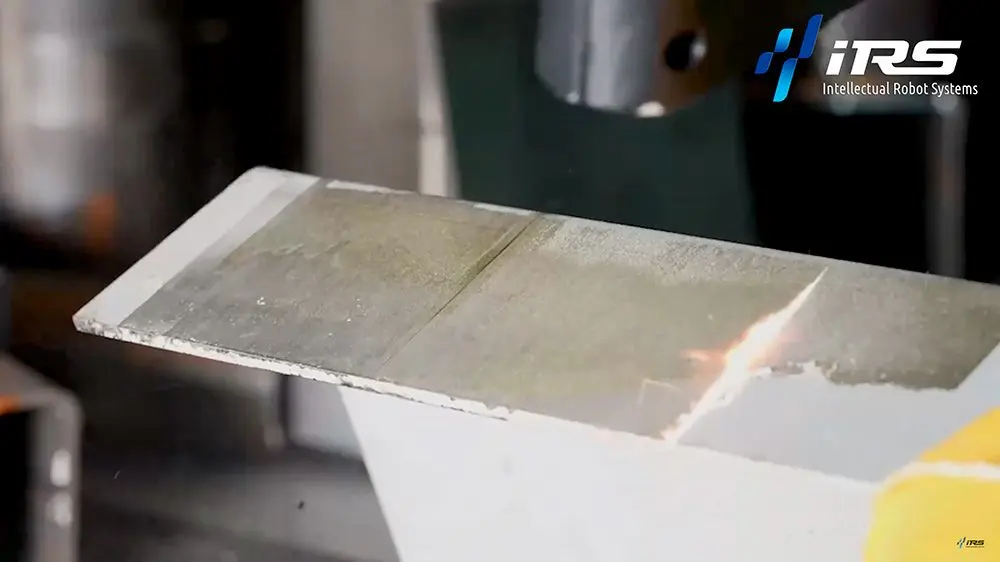
Due to the physical properties of "dry ice," no piles of spent abrasive are needed—it sublimates quickly into the atmosphere.
- Instead of sand, solid CO2 pellets are used. Elegant solution! Solid carbon dioxide sublimates quickly, is chemically inert, and its hardness is slightly lower than regular water ice;
- Precision is better than sand but still not perfect. The low density of dry ice helps, but the kinetic effect is amplified by powerful micro-explosions of pellets on contact—sublimation gas volume is 800× the pellet volume! Micro-pits and dents are guaranteed.
- Automation is advantageous: no leftover sand or abrasive—only removed oxides and contaminants, easy to clear. Yet, as a lighter version of sandblasting, it inherits the older method’s drawbacks, just to a lesser extent.
- Cleaning quality is much higher than the previous two methods. Still, rust and dirt do not evaporate—they can remain in gaps, but micro-explosions scatter contaminants far better than sand, which pushes dust into every crevice. Conveyor lines, moving mechanisms, delicate alloys, and plastics are cleaned much more efficiently than with traditional abrasives.
- The apparatus is not complex but expensive—it combines refrigeration, crushing, and precision air control. Dry ice supply is a partial financial factor. It stores well in thin CO2 layers. In a day, dry ice loses 7–10% of its weight, but can be generated on-site from compressed CO2 cylinders by rapid expansion cooling into flakes. This process has its own costs.
Chemical Method
A treatise could be written about chemical surface cleaning, but the conclusions are basically two:
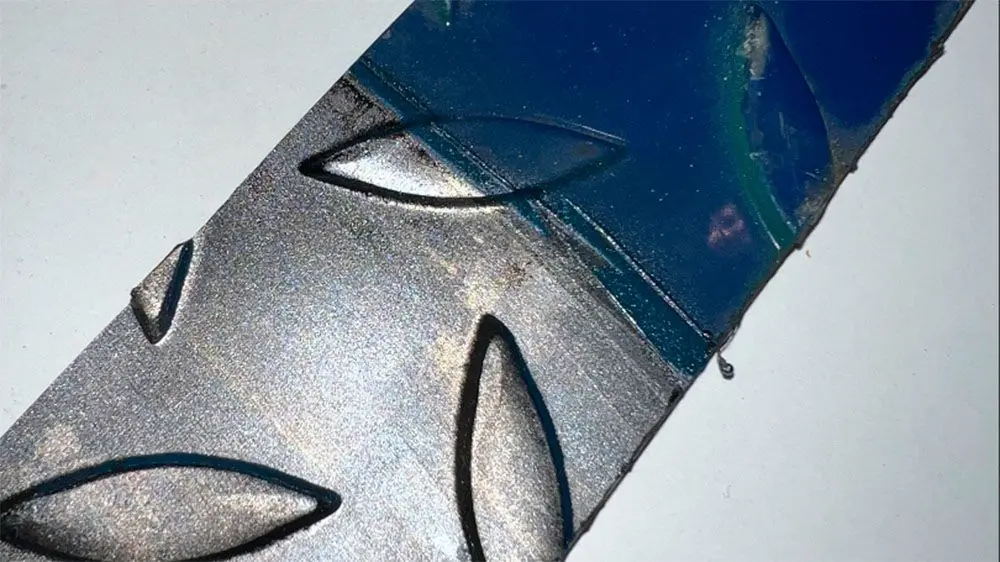
- The chemical method consists of thousands of formulations, varying greatly in cost, complexity, and quality, but it is always possible to achieve 100% results. A specialist and a decent lab are required. For example, vinegar can perfectly remove silver sulfide from a tarnished ring, but 80% of the time a ruby may crack. Using hydrofluoric acid, the ruby shines—but the ring and possibly other objects dissolve. Both achieve 100% success, if the goal is narrow...
- Chemical waste is extremely hazardous, second only to nuclear waste. Industrially, rarely is anything more toxic than hydrochloric acid, but waste disposal is a major technical and bureaucratic headache.
Laser Cleaning
As you can see, all conventional methods have limited success, but each also has significant drawbacks. The CO2 method is slightly ahead, boasting minimal waste and near-complete safety.
Now let's compare these "veterans" with the new generation:
Precision and Accuracy
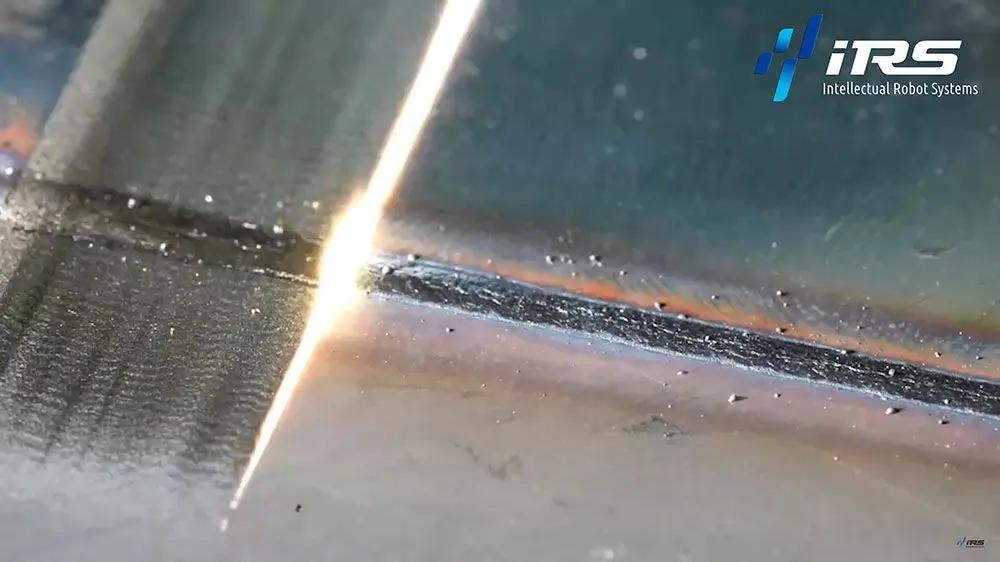
The laser cleaning device is almost identical to a laser welder or cutter. The only difference is the operating mode: the beam is refocused into a light fan and works in pulses. Power, frequency, and pulse duration are adjusted so that a single pulse removes only 1 μm—a hundred times more precise than typical precision metal processing!
The base material is virtually undamaged. This precision allows even concave metal mirrors to be "cut" if desired. The short pulse duration minimizes surface heating, so there’s no risk of melting plastics.
Robotics
For metals, reflective surfaces, glass, and other transparent materials, automation is no more complex than in laser cutting. Reflective or transparent surfaces are "clean" surfaces—the laser beam scatters or reflects without heating or evaporating anything. Therefore, coordination errors or excessive power/pulse intervals cause no damage. For fully opaque objects, careful mode adjustment is sufficient.
Surface Preparation
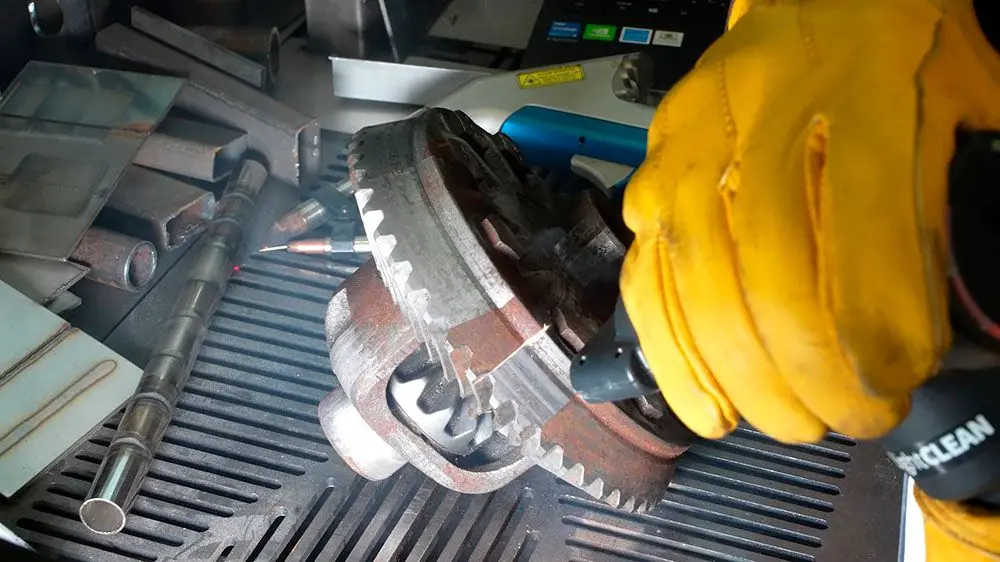
No surface preparation is needed before laser cleaning. The short pulse duration allows safe use even in petrochemical industries, where chemical cleaning is complex, costly, and causes long equipment downtime. Ironically, a person with a powerful laser at a gas station is no more dangerous than a smoker with a lit cigarette 50 meters away.
Plug and Play
The laser cleaner is extremely easy to operate—fully adhering to a "unpack and use" principle. No auxiliary tools or consumables are needed. Modern devices are compact enough to fit in a backpack, requiring only electricity for full mobility.
Costs
Regarding consumables, the laser has only one: the working medium. Average operational life is 50,000 hours, with some models exceeding that. When your five-year continuous work ends, humanity may introduce another laser innovation. Fifty thousand hours is an enormous lifespan.
Safety
Average power of laser sandblasters is 300–500 W, with standard fiber laser wavelength at 1070 nm. This radiation is poorly absorbed by skin, meaning a medium-power device can only burn if the beam focuses on one point for more than a second.
Conclusions
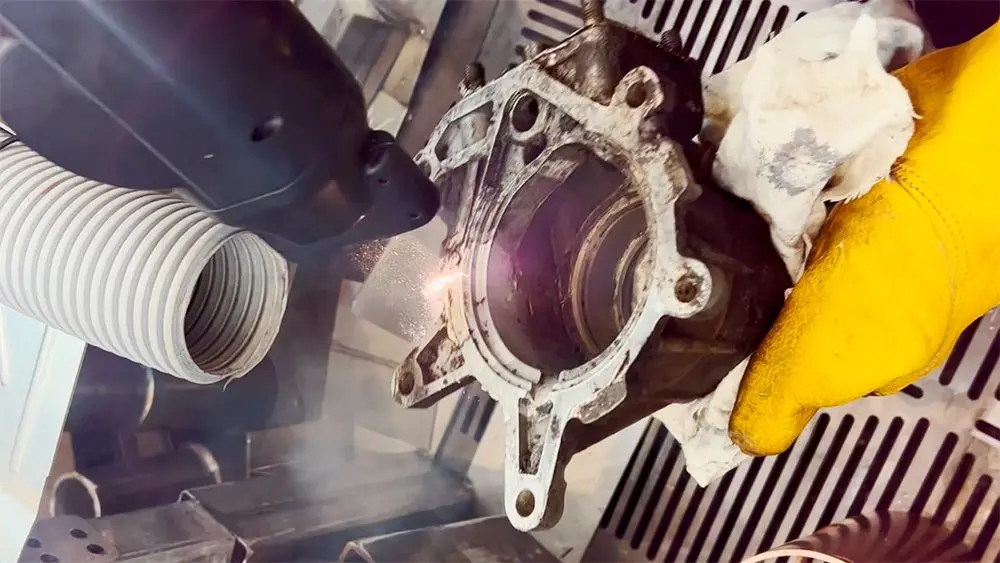
There’s hardly a need for lengthy conclusions: even now, a not-so-cheap medium-sized box can do in seconds what carefully chosen chemical etching accomplishes in minutes.
- Removes a layer from the surface 100 times thinner than what classic precision machining manuals describe.
- Weighs only as much as a quarter sack of potatoes, yet fits easily into a backpack, allowing access to places where a sandblaster cannot reach.
- Unlike CO2 devices, it completely vaporizes dirt, like Klingon phasers.
- And it requires nothing but electricity over an entire continuous five-year operation. Until humanity fully understands the three quarks, we’ll still rely on electrical energy—making laser cleaning the best and most economical option in its category.
