
How to determine the required capacity of a tumbling machine?
Since barrel tumblers and vibratory finishing machines are the most commonly used equipment, this article will focus only on these two types of mass finishing machines.
Manufacturers design tumbling machines based on the total volume of the equipment. The total volume represents the capacity fully occupied by media and parts. However, the theoretical volume is never fully reached, as media and parts need space to move in reality.
Let's calculate the volume of a circular tumbling machine. Its working chamber is toroidal. If the volume of the bowl is unknown, it can be determined using the formula:
V = 1/4π2(D + d)(D - d)2
where D is the bowl diameter and d is the central drum diameter.
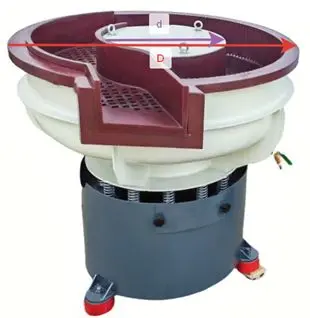
Similarly, the volume of a trough-type machine can be determined, but it should be noted that the theoretical volume is calculated without accounting for the polyurethane lining thickness.
V = a ∗ b ∗ c,
where a is the internal length of the trough bowl without the polyurethane lining,
b — the internal width of the trough bowl without the polyurethane lining,
c — the internal height of the trough bowl without the polyurethane lining.
It is important to understand that the actual volume of a vibratory tumbler is about 80% of the theoretical volume, while for barrel tumblers it is 50–60% of the declared theoretical volume.
Another important parameter is determining the ratio between media and parts. To increase productivity, an operator may sometimes load more parts than recommended by the manufacturer, which can lead to collisions, scratches, and damage to the parts.
Here is a guide to different volume ratios of media to parts:
- 1:1 Media and parts are mixed in equal volumes
- A small amount of media will cause parts to collide and scratch heavily. This may work if surface scratches are not an issue. Suitable for post-casting, rough grinding, and low surface finish requirements.
- 2:1 — 2 parts media, 1 part parts
- A gentler ratio for processing parts, but still allows some scratches and minor damage.
- 3:1 — 3 parts media, 1 part parts
- Friction between parts is present, providing acceptable finishing quality for ferrous metals, minimum ratio for non-ferrous metals.
- 4:1 — 4 parts media, 1 part parts
- Optimal ratio for ferrous metals, provides medium finishing quality for non-ferrous metals like copper, aluminum, etc.
- 5:1 — 5 parts media, 1 part parts
- Ideal ratio for processing non-ferrous metals, minimizing contact between parts.
- 6:1 — 6 parts media, 1 part parts
- Usually used for pre-finishing zinc with plastic media, ideal for processing non-ferrous metals.
- 8:1 — 8 parts media, 1 part parts
- Ratios of 8:1 or higher are used for finishing fragile or irregularly shaped parts, and for more thorough pre-finishing.
Very heavy parts weighing more than 4 kg should be processed separately, either in different machines or in trough-type machines with special dividers. This ensures the best protection from damage during processing.
