
Pulsed and continuous lasers: am I the whitest of them all?
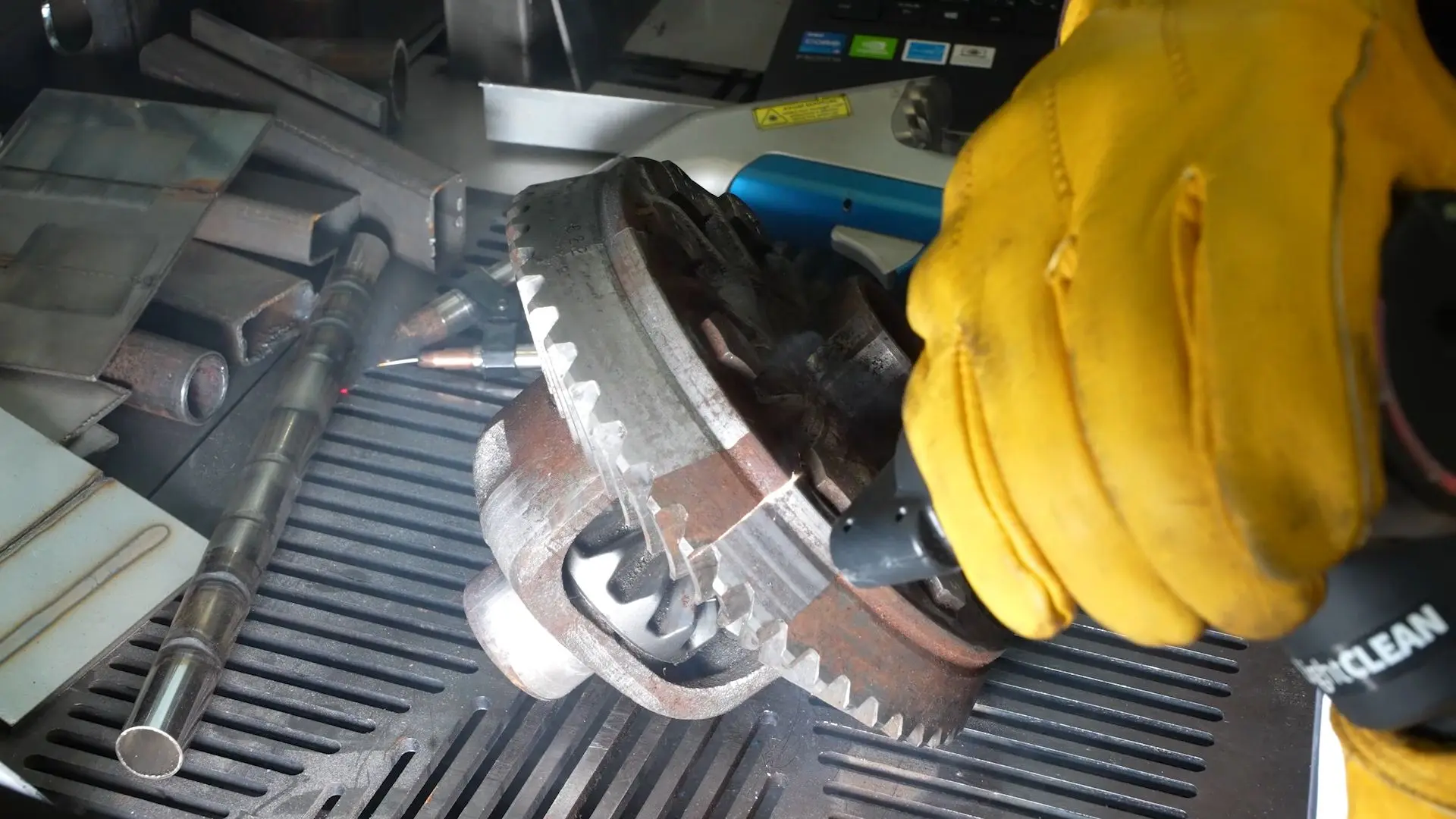
Once upon a time, all curious boys were fascinated by one extremely important question — who would win: RoboCop or the Terminator? Those boys have long since grown into adult engineers, but the question hasn’t changed. It has simply moved into a more practical realm without losing its futuristic appeal: nobody is surprised by space lasers anymore, but some of their applications still evoke childlike excitement.
The most striking impression is left by the most spectacular representatives — laser cleaning devices. Welding and laser cutting are commonplace, but an engineer seeing a cleaning device in action for the first time behaves like a Siberian hermit visited by a geologist. The hermit wasn’t amazed by a radio or TV because he grew up on a fairy tale about “the apple on the golden plate.” But polyethylene stunned him: “Wow… glass, and it bends!”
After the initial wow effect from seeing the laser cleaning device work, the engineer is struck a second time by the strange discrepancy in prices between devices with continuous and pulsed laser sources. Since this difference is substantial, an inexperienced person tends to opt for the cheaper, larger box. Especially because this decision is reinforced by the moss-grown belief that a continuous laser is far more powerful than a pulsed one. This peculiar conclusion is drawn from the simple label on the device: the large continuous box shows 3000W, while the small pulsed one shows a mere 500W. Yet, the small box is often three times more expensive than the large one!
It is necessary to dispel some misconceptions about laser technology. Let’s start with the oldest and most persistent — power, because with lasers the principle “strength is everything, brains are optional” becomes doubly ironic.
Power and Consumption
The casing of the device always indicates the average laser output power. For a continuous laser, this is also the working power. It is also a useful figure for estimating actual electricity consumption. For all types of modern ablation devices, this estimate is roughly the same: multiply the average power by 3, and you get a rough estimate of the device's voracity. This alone can unsettle those interested in a 3-kilowatt box — it’s hard to directly power it even in a simple garage.
Meanwhile, a compact pulsed laser device provides power spikes 5, 10, or sometimes even more times higher than the average. The peak pulse energy is the working power: a laser with the consumption of a home computer and a power supply of only 500W can actually deliver 5 kW of real beam power! Think of the insane PMPO Watts on Chinese audio systems: a sticker can say a lot, but reality is different…
And that’s just the first layer of misconceptions and advertising tricks.
Consequences of Chemical Attack
The power of a continuous laser has one property that non-chemist engineers often overlook, though it is very important. If you need to clean metal surfaces from paint, plastic, enamel, or fuels and lubricants, it has to be done outdoors or at least with a proper respirator. With some paints, even a gas mask won’t help. And it’s also good to have a CO2 fire extinguisher on hand.
The continuous laser emits power constantly, so flames, soot, and foul smoke are also constant. The surface doesn’t have time to cool, so the entire cleaning process is accompanied by burning and evaporation. Imagine if there’s plastic with nitrogen or chlorine under the beam: almost all nitrogen-containing organic compounds are toxic, and chlorine is a top-tier chemical weapon.
Pulsed lasers almost don’t have this disadvantage, because heating occurs only at the beam focus. The surrounding area does not heat up.
If you haven’t burned your lungs with chlorine yet, there are two simpler problems that directly affect processing quality: local melting, if noticed through the smoke, and deposition of combustion products from soot to rust directly into the weld — continuous lasers are prone to this.
While local melting could be easily handled, smoke causes condensation, including from the plasma cloud. Rust is partly composed of substrate metal atoms, so the plasma contains radicals. The physical properties of radicals do not differ from elemental atoms. Under continuous laser radiation, the plasma reflects the beam and smoke absorbs it. Both plasma and smoke constantly change shape while the beam energy is applied continuously, chaotically reflecting and losing about half of its energy. Predicting or influencing this process is almost impossible, and it leads to uneven cooling, rust deposition in the weld, and formation of caverns — making welds neither elastic nor reliably strong.
This is why cleaning with a continuous laser looks much rougher, like after ordinary abrasive scraping.
Microns vs Degrees
Understand that the purpose of an ablation device is cleaning, not heating a supernova or yourself. An unthinking continuous beam with unregulated power effectively converts supplied electricity into heat everywhere: from the device to the workpiece. At best, only 30% of the energy reaches the work area. That means your imagined 3 kW device converts 3 kW into useful beam energy but wastes 7 kW heating the surroundings! For comparison, touching a transparent 1 kW outdoor spotlight in winter guarantees a hand burn. Electricity meter readings will shatter the fantasy of owning this miracle device.
In contrast, a pulsed laser delivers 70% of the energy to the beam. Internal energy fluctuations only lose 30%, making cooling at least twice as easy compared to a continuous laser. In addition to saving electricity, the device weight is much lower. This explains why pulsed laser devices don’t impress with massive size, but delight your wallet.
Each pulse is at least 3–5 times more powerful than the average working energy of a continuous laser at the same supply power, meaning it works more selectively and effectively due to brevity. Typically, pulsed ablation devices remove about 1 µm of rust and contaminants per pass. So, for non-precision or non-jewelry workpieces, you don’t have to worry about how long the beam is focused on the same spot — even a hundred microns won’t damage a DVD drive worm gear. For precision parts, it’s better to avoid continuous lasers, which can remove 0.1 mm at once — unacceptable for steel automotive blanks!
A pulse guarantees that the focused area heats to +1600 ℃, while surrounding material barely warms up. Substrate temperature changes by only 3–5 ℃, meaning pulsed lasers can process light, flammable plastics without risk of melting.
Continuous lasers are, of course, dangerous. To get a noticeable burn from a pulsed device, you need to aim at your hand for 5–10 seconds, which is a long time.
Loading and Unloading
Owners rarely consider this before purchase but regret it later — the laser’s cooling system must be powerful for all types. Continuous lasers require much more heat dissipation than pulsed ones. Cooling type — passive, air, or liquid — doesn’t matter much; liquid cooling only complicates minor repairs. Cooling always increases device size and weight.
Estimate that each kW adds 10–20 kg to a “hobbyist” device. “Medium” devices weigh around 500 W. But a wheeled 500 W box already weighs half a quintal and isn’t mobile. A 100 W pulsed device, brick-sized and weighing two bricks, can deliver 1 kW pulses, which a continuous 100–150 kg laser struggles to achieve!
Balancing the Scale
We didn’t conduct formal experiments, but our experience suggests approximate results:
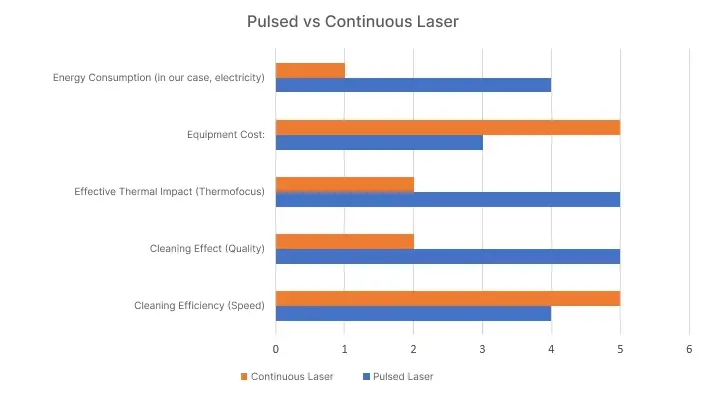
Pulsed 21⭐ are still better than 16 continuous ⭐. Arithmetic doesn’t lie.
