At the first stage, the production of assembly and inspection plates is identical and begins with preparation for casting. Before pouring the workpiece, it is necessary to form a casting cavity in the shape of the plate. For this purpose, a special device – a casting mold (flask) – is made, which resembles two connected boxes. A polystyrene model is placed in one of these boxes, and the remaining free space is filled with molding sand. After that, the sand is tamped down. Thus, the preparation for casting is complete, and the molten cast iron can be poured.
After the metal has completely cooled, the next stage of production begins, which consists of mechanical processing. When manufacturing mounting plates with T-slots, the surface of the plate is mechanically processed, and then T-slots are milled using a CNC machine.
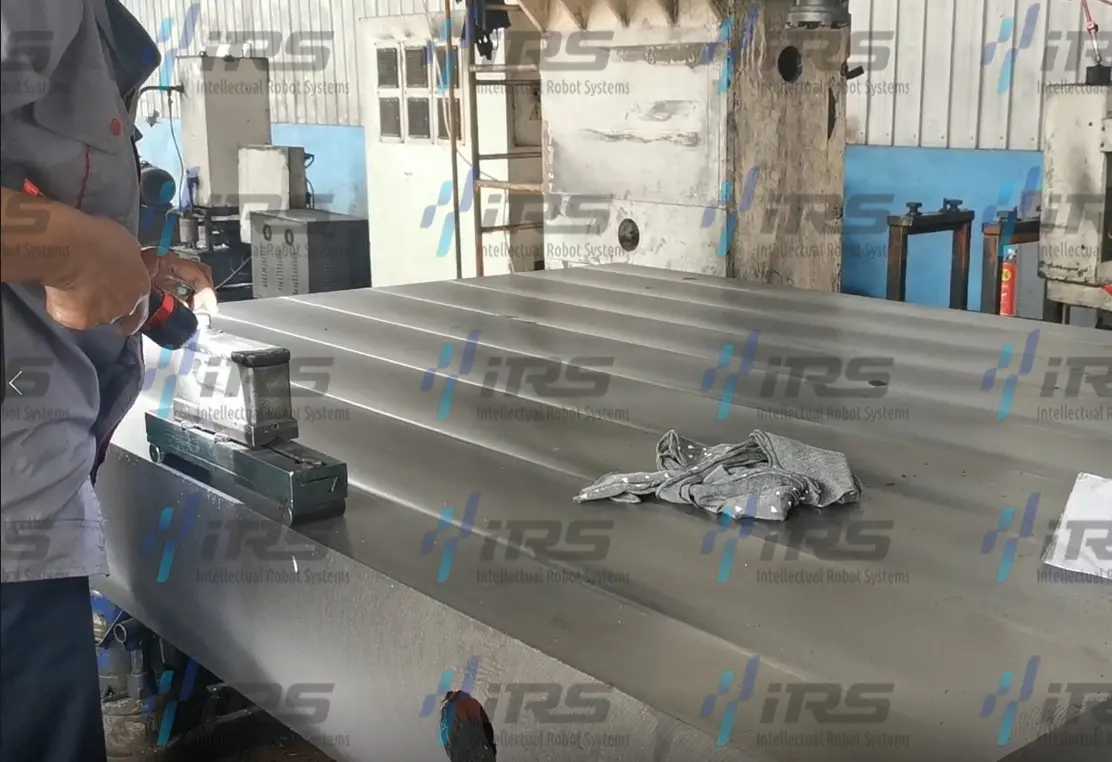
Unlike the production of mounting plates, the manufacturing process of surface plates has its own specifics. The main requirement here is precision, which is achieved by grinding on longitudinal grinding machines capable of achieving a surface roughness of up to Ra 0.63 and a flatness tolerance of up to 0.025 mm.
After mechanical processing, the working surfaces of the plates are treated with oil and sealed in protective film. We manufacture surface and mounting plates in accordance with GOST standards and provide warranty and post-warranty service.