
High-Speed 3D Printer
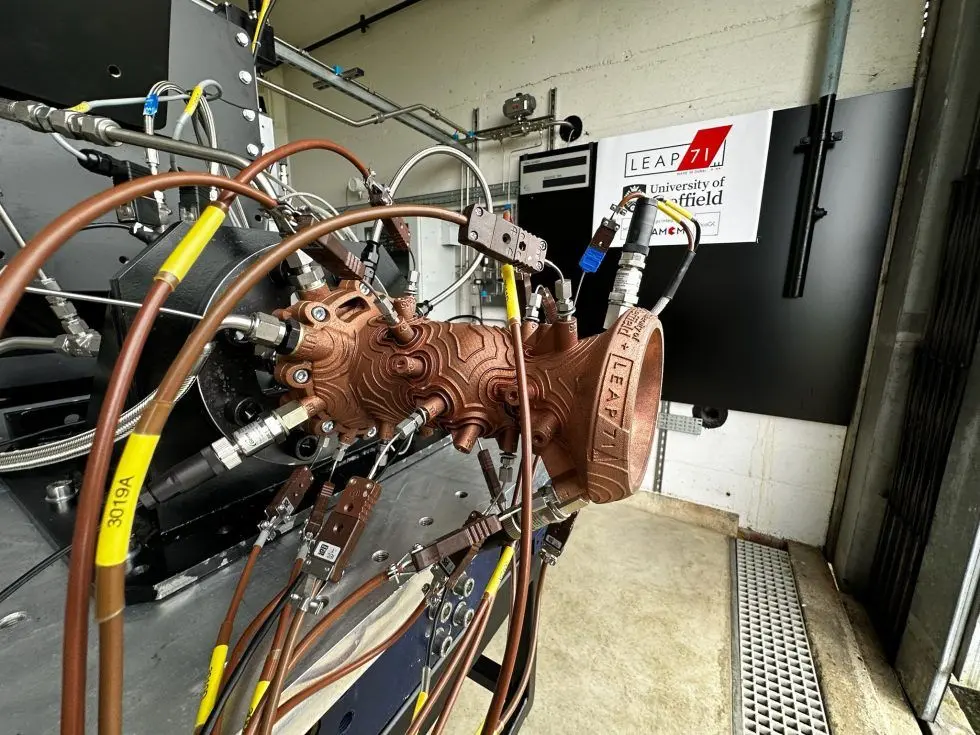
More precisely, the opposite: not the printer itself, but the result of its printing. Imagine a rocket engine printed in two weeks with all preliminary calculations, and fully functional.
As Always, British Scientists
A rather outdated (about 30 years old) liquid-fuel rocket engine was tested at not the best university in the UK, the University of Sheffield — already a dull start for a budget series. But here’s the twist…
A group of provincial scientists tried to rapidly launch a full engine design from CAD composition and assembly to complete material selection, but using artificial intelligence. Normally, this is done by a team at NASA, Boeing, or AeroSpace over 6–12 months. BAES is slightly faster, since they have experience building the Concorde, and could have done it in 4–5 months with a team of 50 people… But these are British scientists, they couldn’t resist: two obsessive enthusiasts managed it in two weeks from starting calculations with absolutely no CAD (really none!) to an engine that successfully passed its first ground thrust test — essentially a “live-fire” preparation. On the test range, in real life!
The most time-consuming part was the final finishing of parts from burrs. Two slightly eccentric professors filed the seams after AI had done its work, nothing more. Without those two extra days, they would have completed it in just 10 days.
The project for processing complex objects using AI was proposed by the startup LEAP 71, based in Dubai, although it is a British inter-university team including the University of Sheffield. The desert location makes it less risky to blow something up, but nothing exploded.
Programmers created the Noyron model, which had appeared twice in the IT press with modest achievements, then disappeared for three years. Colonel Thomas Lawrence “the Arabian” also disappeared in Arabia for two years, then immediately captured the port of Aqaba with a crowd of unorganized Arabs. Later, Damascus. Happens. Noyron did the same.
Apparently, over the 2–3 years, the AI algorithm was fed designs, machines, and mechanisms for any field, not just aerospace. The British claim that it can design anything: from a toy to a space shuttle. And throughout the process, no CAD software was used at all — “they only added confusion with their fossilized algorithms.” I believe it, having used it myself and sometimes pulling my hair out.
The Details
The engine designed in two weeks runs on a two-component kerosene and liquid oxygen system — not the most modern method for launching rocket engines, but still in use.
However, the “ground fire” test data looks unusual: normally such values are obtained with 1.5× overdrive, but these are standard figures. Even the swirl injectors worked perfectly.

At the military test site AeroEngineering in Wescotte, the engine, with a modest 5 kN thrust (500 kgf, the old-fashioned way), easily showed all calculated figures. It took only 3.5 seconds to warm up, then it ran at full power, completing 12 basic seconds of the test without failure, generating 20,000 horsepower.
Essentially, the “British scientists” built an engine suitable for the second or third stage of any modern rocket.
The most astonishing thing is that the AI model Noyron can produce new engine versions (the swirl injectors can have an infinite number of geometric modifications) every 15 minutes on a regular home gaming PC, not even top-of-the-line.
Metallurgy
All components were printed on an EOS M290 printer costing $700,000. But the key is not the printer itself — cheaper alternatives exist — but the alloy and cooling management. The alloy is fairly standard: Cu-Cr-Zr, with no more than 0.9% chromium and zirconium at 0.15%, if not less. Such alloys can be purchased from any online copper supplier. That’s exactly what the British scientists did.
However, the copper must melt instantly. In the engine’s hot chamber, the temperature reaches 3000 ℃, which is why AI was used to calculate cooling for all surfaces, some exceeding 400 ℃. Why not supply chilled fuel, i.e., kerosene, through embedded microchannels 0.8 mm in diameter? AI asked “Yes?” The British scientists replied “Exactly!” The final engine casing temperature did not exceed a modest 250 ℃. Ideally, a cooling system failure would instantly turn the device into molten copper on a concrete floor, but everything functioned correctly with a safety margin. This margin allows overdriving the engine by 1.5×.
However, the British scientists have already abandoned the project, handing it over to the Americans — they are now focused on cooling elements for the upcoming launch of the Chinese Tokamak. Reports indicate that the Chinese successfully launched their own nuclear fusion device and are seeking solutions to confine plasma.
Such are the British scientists. Sometimes, you don’t need to play the violin to surprise the world.
