
Lightweight flying dump truck
Before scaring you with flights over the city, it’s worth talking about the “cockroaches in the pilot’s head.” They are few, but they exist.
For older aircraft models that have proven themselves, in addition to operational rules, there are empirical observations from generations of pilots who flew these old dinosaurs. How much cargo can be taken on board, what speed to take off and land, how strong crosswinds can be, and a few other basic metrics. These are core parameters that permanently embed themselves in the pilot’s subconscious after flying experience.
But times changed drastically with the arrival of the first production Hawker Siddeley Harrier GR.1 — a British vertical take-off jet that could lift off not along the carrier deck, but perpendicular to it, i.e., straight up. All pilot habits were broken so thoroughly that after a few years, the Admiralty abandoned retraining programs for veteran pilots, only accepting cadets with at most 20 hours of helicopter experience (controlling a copter differs significantly from conventional aircraft).
A series of minor accidents quickly revealed some interesting patterns, known to Sikorsky at the start of the 20th century, but largely forgotten by the 1960s with the rise of jet engines. For example, any heavier-than-air craft can carry no more than 2/3 of its own weight in cargo. But if the cargo weighs half the aircraft’s weight, it will definitely lift it — essentially an air taxi.
Air Taxi
Once quadcopters began being built even by schoolkids, a dozen companies emerged, dreaming of urban air taxis—given enough funding and investors. All of them abandoned internal combustion engines, focusing entirely on electric motors. This makes sense for reliability and operational longevity. You can’t just pull over in the air to refuel.
Two main problems arose immediately: battery capacity and weight. Naturally, an air taxi must take off and land vertically. But the old empirical rule “broke”: battery weight became a rigid parameter in flight performance calculations—exceeding half the aircraft’s weight (without passengers and pilot). The classic 2/3 rule shrank to 1/6 or less.
Almost all companies initially succeeded with lightweight aircraft, carrying up to 160 kg of payload for a hundred or so kilometers at a maximum weight of 600–800 kg. Pilot, passenger, and luggage. Excellent from an engineering perspective, but a failure for B2C and forget B2B—80% of battery energy went into lifting the aircraft itself, giving only 30 minutes to 1.5 hours of flight followed by “slow” half-day charging. A successful business needed a fleet of 30 constantly active (flying or charging) aircraft, otherwise the venture wouldn’t pay off.
Batteries also have a so-called C-rate, indicating the charge-to-discharge ratio. Sometimes you can charge overnight to expend the energy in a 10-minute sprint during emergencies, while still allowing a soft landing. Logically, an air taxi must have this high-power discharge option. Again: you can’t pull over in mid-air. Battery costs for C10, C100, and C1000 differ by an order of magnitude each.
Ilya Muromets of Taxis
If you Google “Ilya Muromets airplane,” you’ll see Sikorsky’s monster had six engines, was the world’s first passenger plane, and took off at speeds of 100–140 km/h.
It’s time to repeat that “foolishness” with electric motors and variable geometry. This will also be the first truly passenger-carrying model.
Archer Aviation, developer of electric vertical take-off and landing aircraft (eVTOL — electric vertical take off and landing), not only lifted a three-ton monster (previous industrial limit was 1,200 kg), but also completed all basic vertical take-off and landing protocols. Amusingly, the design strongly resembles old Sikorsky aircraft. Take-off is straightforward, but landing with a 10-knot crosswind… modern kids can program quadcopters for tougher conditions, but not for a three-ton monster.
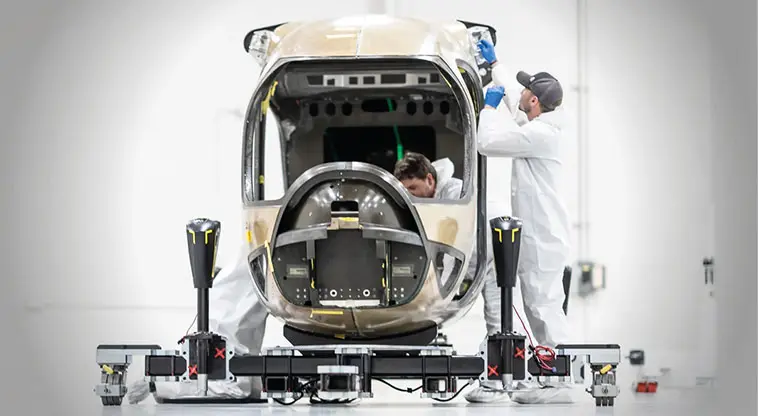
Recall the empirical rule: a 2,950 kg aircraft should be able to lift at least 1.5 tons of payload. According to unofficial sources, Archer has already achieved this, but as always, we await PR teams and internal marketers who will spend months creating presentations instead of providing straightforward specs. The video already demonstrates the performance.
The pilot completed the most complex maneuver for such aircraft: vertical take-off like a helicopter, transition to horizontal flight like a plane, then back to vertical before landing.
Three tons fly like a bumblebee, but they do fly:
The craft managed this feat at cruising speeds slightly over 100 mph (160 km/h). Comparable to WWI aircraft speeds when the Camel fighter weighed 150 kg including its engine!
All aircraft in the table below are jets and barely qualify as modern, but they are well-known:
- Boeing 737 lifts off at a minimum of 220 km/h;
- Il-96 slightly heavier — 250 km/h;
- Tu-154M — 210 km/h, though slimmer than Il-96;
- Finally, the old Yak-40/42 — 180 km/h;
But technical specs are not the most interesting part of this story.
Archer has already received FAA certification required to begin commercial eVTOL operations in the U.S. and now plans test flights of the prototype for final certification.
After receiving ICAO approval, this bumblebee will become a fully commercial machine worldwide. India, China, and UAE are already in “take our money!” mode.
This is the next cycle of flight controller programming. Schoolkids will have fun with air routes. No joke.
