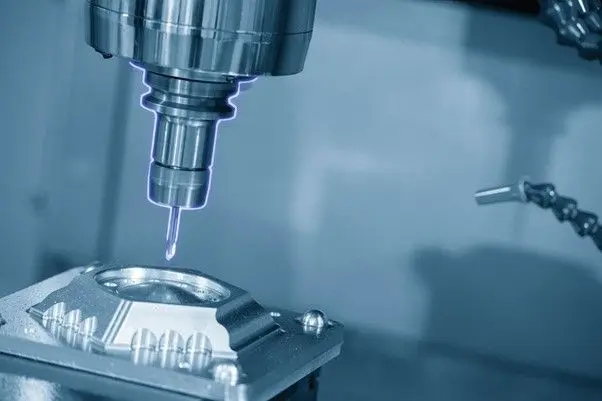
Materials used in aviation and spacecraft feature enhanced performance characteristics. However, working with them comes with numerous challenges: rapid tool wear, low machining efficiency, and poor surface quality. A solution has been proposed by researchers from Nanjing University of Aeronautics and Astronautics.
Hybrid Methods in Mechanical Processing
The aerospace industry constantly develops and adopts new materials: high-strength and heat-resistant alloys, composites based on metals, ceramics, and polymers. As a rule, the ability to operate under extreme conditions comes at the cost of manufacturing difficulties. High cutting forces and heat quickly wear out tools, reduce surface quality, and lower process productivity.
A group of Chinese scientists sees potential in applying unconventional methods to influence materials. The authors presented a thematic review dedicated to nontraditional energy-assisted mechanical machining. Essentially, it is a compilation of successful scientific studies on the subject (over 320 references) and a celebration of TRIZ methodology.
Hybrid machining methods are based on traditional mechanical processing (cutting or abrasive action), which remains the primary method of material removal. However, local exposure to “nontraditional” energy (vibration, electric current, and others) significantly simplifies the machining process. For example, ultrasound alters the contact conditions between the tool and the workpiece, a magnetic field affects the workpiece kinematics, and a laser simply evaporates the surface.
Energy-assisted methods reduce work hardening, residual stresses, and delamination of the workpiece. As a result, tool wear and scrap rates decrease noticeably. At the same time, the surface finish and dimensional accuracy improve.
Examples of “Nontraditional” Mechanical Machining
It is important to note that these methods apply to extremely hard, brittle, or anisotropic materials that are difficult to machine conventionally. In all cases, energy-assisted techniques reduce cutting forces and surface roughness while increasing tool life.
In manufacturing, “hybridization” refers to combining two or more separate processes into a single system.
Example: a laser cladding head and powder feeder are installed on a 5-axis CNC milling machine. First, the laser forms a near-net-shape workpiece with minimal stock, and then the spindle, using different tools, machines it to its final dimensions.
Such a machine offers high accuracy, eliminates the need for part repositioning and re-setup, and improves both product quality and process productivity.
Often, the term “hybrid manufacturing” refers specifically to this technology. But the authors of the article focus solely on innovations still inside research laboratories.
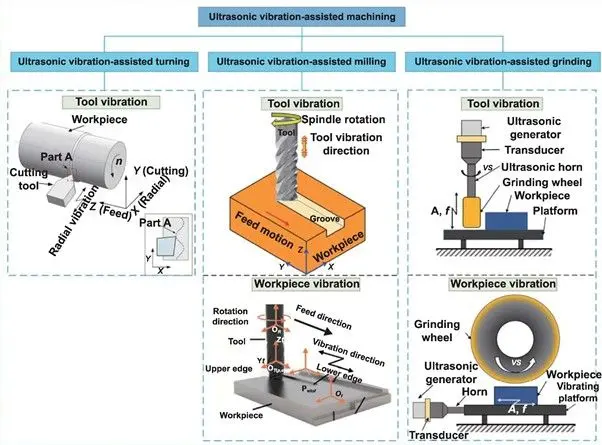
Vibration
When combined with traditional machining methods (turning, milling, grinding), ultrasound (>20 kHz) alters the trajectory of the tool and the workpiece. For example, when vibrations were applied to a turning tool, the cutting mode changed from continuous to intermittent, and cutting forces dropped by 40%.
Ultrasonic vibration milling induces high-frequency compression of the workpiece by the tool, increasing surface hardness by 80%. In addition, near-surface grains are refined, and a single operation can increase the depth of the plastically deformed layer by almost 80%, improving the fatigue life of the machined component.
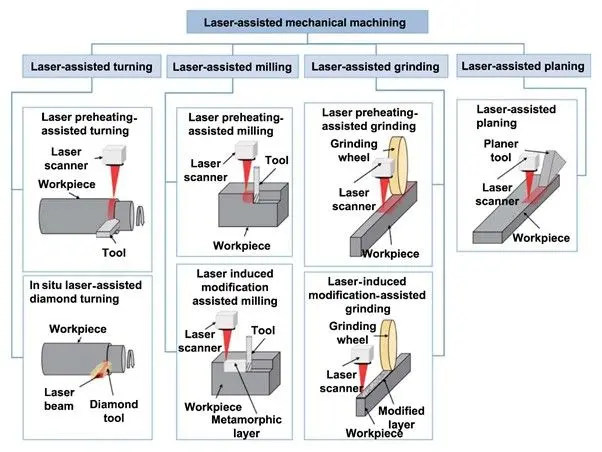
Laser
Laser-assisted machining relies on preheating, evaporation, or altering the microstructure of the material. For example, at elevated temperatures, ceramics and cemented carbides transition from brittle to ductile deformation modes, directly improving surface finish.
Laser-assisted turning of an aluminum-matrix composite reinforced with silicon carbide particles reduced cutting forces by 63%, tool wear by 65%, and surface roughness by 75%.
In another case, a pulsed laser was used to oxidize the workpiece surface. Loose and porous oxides formed and were easily removed by the cutting tool. However, this method is not suitable for all materials—for example, oxide ceramics and glass, which poorly absorb laser radiation, cannot be processed in this way.
Combining laser and vibration in turning reduced cutting forces by 68% and increased tool life by 95%.
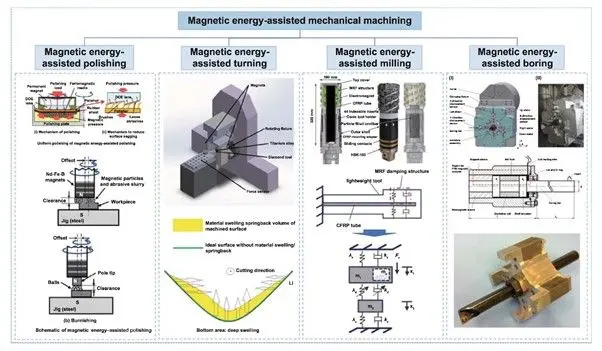
Magnetic Field
During turning, an external magnetic field can provide eddy-current damping of the workpiece, compensating for machining-induced vibration. As vibration decreases, tool life increases and geometric accuracy improves. In one experiment, surface roughness decreased by 55%, and cutting forces by 66%. Additionally, long, continuous, smooth chips formed, indicating a stable cutting process. The form error of Ti-6Al-4V samples was less than 4%, whereas conventional turning produced errors in the range of 25–37%.
Prospects of Hybrid Methods
Before “nontraditional” technologies can be applied in the aerospace industry, researchers and engineers must overcome several challenges. For example, machining complex geometries requires precise synchronization between the laser beam and the cutting tool.
“To improve the efficiency of vibration-assisted machining, it is crucial to enhance the performance of vibration equipment,” says Dr. Biao Zhao, one of the authors of the review, “and to develop innovative tools compatible with ultrasonic vibrations.”
In other words, hybrid machining methods remain a promising concept. But they work, so it is clear that some of them will eventually find the right balance between efficiency, quality, and cost, meeting industrial production requirements.
“On the journey from laboratory to factory, hybrid methods still have a long way to go,” says Professor Ding. “Further fundamental research, technological breakthroughs, and equipment development are needed. This is an interdisciplinary field that encompasses mechanics, physics, chemistry, and materials science.”