
Electricity from a piece of concrete
At the MIT (Massachusetts Institute of Technology) Cambridge laboratory, a routine industrial experiment was conducted: it was necessary to test the dielectric breakdown of another version of an already not-so-new material—layered concrete reinforced with carbon fiber or fabric. The industry is gradually moving away from traditional reinforced concrete, as metal rods still corrode, are expensive, heavy, and require significantly more time and effort during installation and pouring than relatively simple operations with carbon fabric.
Steel is gradually being replaced by carbon, and this is natural. However, even during the era of steel construction, unpleasant side effects of reinforced concrete were observed—electrical breakdown. In industrial buildings, this was a serious problem, as a 10 kV cable is standard even for a small café on the first floor. In principle, breakdowns were also not uncommon in multi-apartment buildings, although the control for residential buildings was much stricter.
The essence of the experiment was simple: for a given voltage, determine the thickness of the "pancakes" of concrete, separated by a layer of carbon fabric, so that there would not be excessive voltage between the layers. In theory, this study was intended for a metrologist rather than a graduate researcher. But for this routine work, only one person was assigned—a rare case in modern science where the fame of discovery belongs entirely to a single young person.
Damien Stefaniuk loaded the next set of layered pancakes into the rack, applied voltage, measured, switched off the setup, and was about to leave the laboratory, but... the signal LED did not go out. The entire experimental setup behaved like a battery or capacitor.

Any amateur radio enthusiast with experience would immediately realize that this response is reminiscent of the 1930s, when the boom of home radios began. An electrolytic capacitor, which is constructed in the same way, can hold a charge of up to 24 V for about two days—among TV and HF radio repairers, there used to be a joke: "Kill N times, I’ll see the cat": n times (foil layer/paper layer) + electrolyte. For compactness, even modern capacitors roll long strips of foil and paper into a coil, but the principle remains the same.
In Damien Stefaniuk's experiment, concrete served as the dielectric instead of paper, and carbon fabric replaced the foil. Only there is no electrolyte. And anyway, concrete cannot be filled with electrolyte or even epoxy electrolyte—it would be useless, as the hygroscopic nature of concrete is difficult to suppress.
Initially, it was necessary to check the overall potential of the effect. A single pair of half-inch-thick "pancakes" was enough to power an LED—3.3 V and 0.06 W—a modest result. However, a dozen "pancakes" could already deliver enough power to run a light CPU cooler and a handheld gaming console.
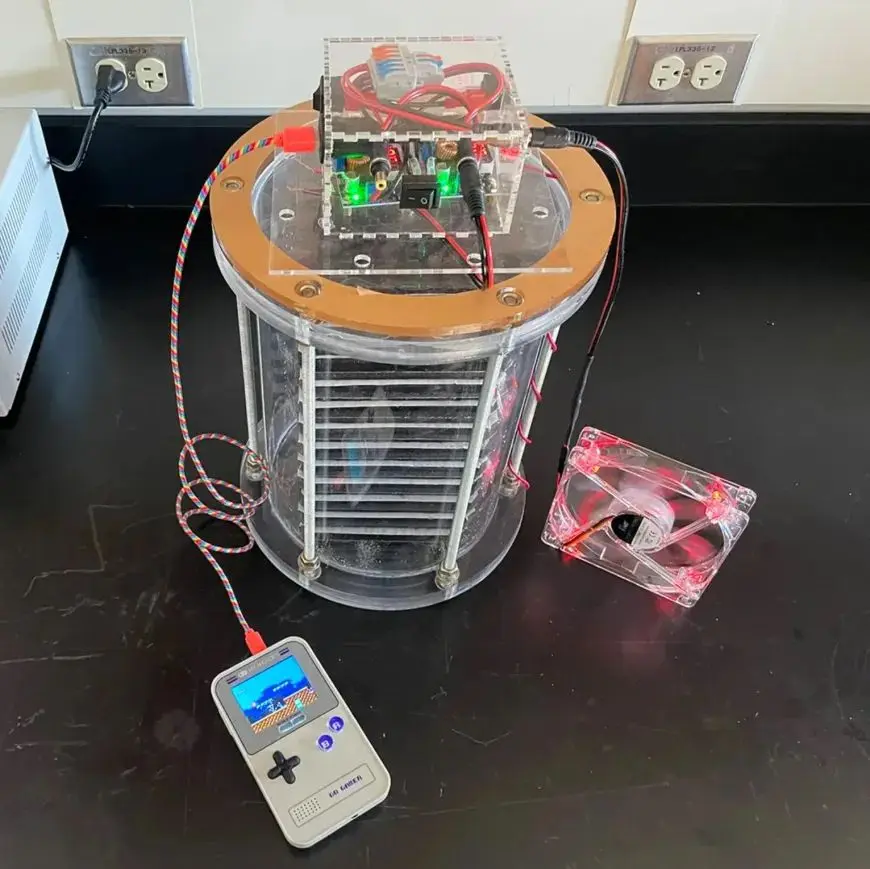
Looking ahead, one cubic meter of the same layered concrete, but industrial grade (with layers not half-inch thick but at least 2–3 inches), could store up to 0.3 kWh. This would power a 10–12 W LED lamp for about 36 hours. In terms of illumination, this is equivalent to a classic 60 W bulb. Not very bright, but long enough to spark interest in the effect.
Now let's talk about the advantages
The point is, many ideas for storing solar energy have been proposed. Let’s consider the most urgent and understandable solution. Imagine installing solar panels on your roof—in the Greater London area, this has been widely practiced for about 20 years, but without scale it would be meaningless. Now you’ll understand.
The essence is that electricity is rarely needed during the day, but solar panels stop producing at night. Usually, a few battery banks are installed in the basement, enough to store energy from 20 m2 of cheap silicon panels with no more than 20% efficiency on a sunny day. And while panels cost a couple of pounds per square foot, batteries are expensive, enough to power lighting, a couple of computers, and occasionally a microwave or coffee machine. Energy would last 5–7 hours, which is quite good. But a refrigerator would consume this household setup in 30–60 minutes and push the battery into the "negative"—chemical coma! Chemical reactions are always reactive. Controllers themselves require about a third of the battery’s rated power to bring it out of stdout state. In any case, it’s too complicated.
Even the best lithium-ion batteries last no more than 800–1000 charge/discharge cycles and degrade over time. They need replacing every few years, which is expensive for computer UPS systems. And if they catch fire, no fire extinguisher can help—Li-Ion fires cannot be extinguished in principle—ask any firefighter.
Londoners found a way to get rid of batteries entirely: during the day, they store energy from solar panels, possibly use some, but all excess goes into the GRID! Your electricity meter runs backward, and you are paid for the energy. Industrial enterprises working during the day gladly consume your surplus. In the evening, the meter runs normally, as you use electricity in the usual way. Over a year, the delta can reach up to £500.
The second solution is elegant and allows you to store energy exclusively for yourself: a water tower—sounds a bit strange?
But no. During the day, energy is used to pump water into a higher tank, storing potential energy. In the U.S. Midwest, this is a common way to avoid using a generator for evening electricity. In the evening, water flows through a mini-turbine, simulating a home hydroelectric plant. However, maintenance of the mechanical and hydraulic systems will still consume the budget and personal time more than lithium-ion batteries.
Now imagine that at least your entire concrete foundation is a battery, lasting 30–50 years without maintenance. And what if it’s a huge concrete industrial building?
Yet the "concrete" project has one huge flaw.
Problems
Conventional electronic capacitors completely isolate the working elements from the external environment. They are sealed in airtight cases, preventing oxygen or moisture ingress. Concrete, however, is hygroscopic, with myriad micropores between randomly fused aluminosilicate crystals, so there is always a small but sufficient amount of water for leakage. Even if the concrete contacts only the atmosphere, osmosis has always been a major problem for electricians.
Theoretically, this can be mitigated by coating external surfaces with plastic, but this trick won’t work for foundations. Experiments in Denver in the 1980s failed completely, although DMC attempted to build a whole car factory without electrostatics or induced electromagnetic interference. After that last attempt, the city “died.”
However, if leakage over a night is minimal, dividends can be calculated. Preliminary estimates suggest industrial concrete will lose 20–30% of its charge over 12 hours, which is acceptable even for industrial use.
Currently, the project is undergoing SEC certification. Surprisingly, it is financiers checking the engineers—SEC monitors stock issuance on the NY exchange.
