
A long-lasting battery
The California company Infinity Power claims to have developed a very powerful and long-lasting nuclear battery using electrochemical energy conversion. The key word here is “powerful”.
In fact, the technology is not new and has been actively developed for about two decades. However, the energy efficiency of such batteries is minimal, even though they operate for at least 100–150 years, making them ideal power sources for low-power electronics. For example, they are suitable for BLE (Bluetooth Low Energy — Bluetooth versions 4.2 and above, where a transmitter can operate from a single standard coin cell battery for approximately two years).
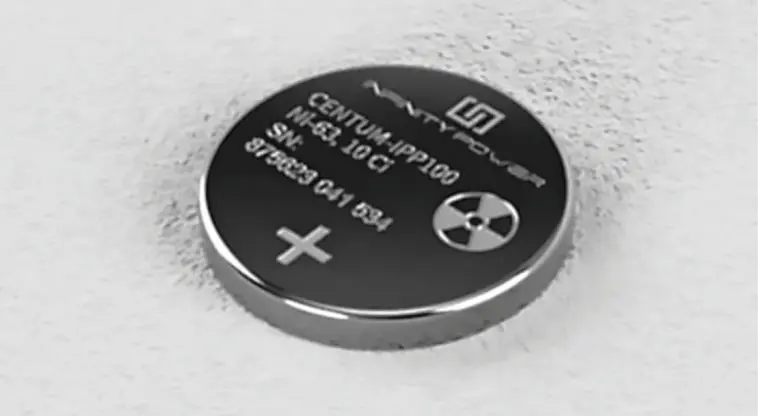
But this time, the classic decay-to-semiconductor ionization conversion was replaced with something new. Unfortunately, the development is overseen by the U.S. Department of Defense, so even general theoretical explanations are absent from peer-reviewed journals. This information is nowhere to be found, not even in patent offices, where one might normally glean at least the basic principles of the new method.
Infinity Power claims that its battery demonstrates an overall efficiency of over 60%, whereas even the best British and Chinese developments in this field typically reached only a few percent, usually 6–8%. No one has achieved 10% yet!
Classic radioisotope batteries work on the principle of converting decay energy into electricity using semiconductor elements. There is little public knowledge about them, but the concept is clear: decay energy is captured similarly to a photovoltaic cell. However, unlike typical converters, Infinity Power claims that its battery uses a new electrochemical energy conversion method.
Strangely, chemical reactions have always lagged behind direct energy conversions in both speed and efficiency.
And it gets bigger
The next claim by Infinity Power starts to sound like “and here comes Ostap”: the technology is scalable and can produce a wide range of electricity—from nanowatts to kilowatts and beyond, which seems a bit hard to believe.
“Thanks to higher efficiency, producing the same amount of energy requires fewer radioisotopes than other conversion processes,” the statement says. “Additionally, compared to previous methods, which offered only a limited choice, this method provides a much wider selection of radioisotope materials.”
Assuming there really is a sufficient variety of radioisotopes, from long-lasting but expensive radium to cheaper lab-grade polonium, which can still last a decade. The company has hinted that it will start sending out commercial offers by the end of the year. So, it’s either a mega-scam for an IPO or a groundbreaking breakthrough.
For comparison, in January, the Chinese company Beijing Betavolt New Energy Technology Company Ltd announced the development of its own miniature battery, which can reliably and autonomously generate electricity for 50 years—well within current development standards. According to them, the battery is currently in the pilot stage and will enter mass production this fall, with a phenomenal 17% efficiency and stable 3.3 V output for at least two-thirds of its half-century lifespan.
Meanwhile, Infinity Power promises a crazy 60%, which they claim is the lower (!) efficiency limit. One can believe almost anything, but some claims are best trusted only after a technological demonstration.
